
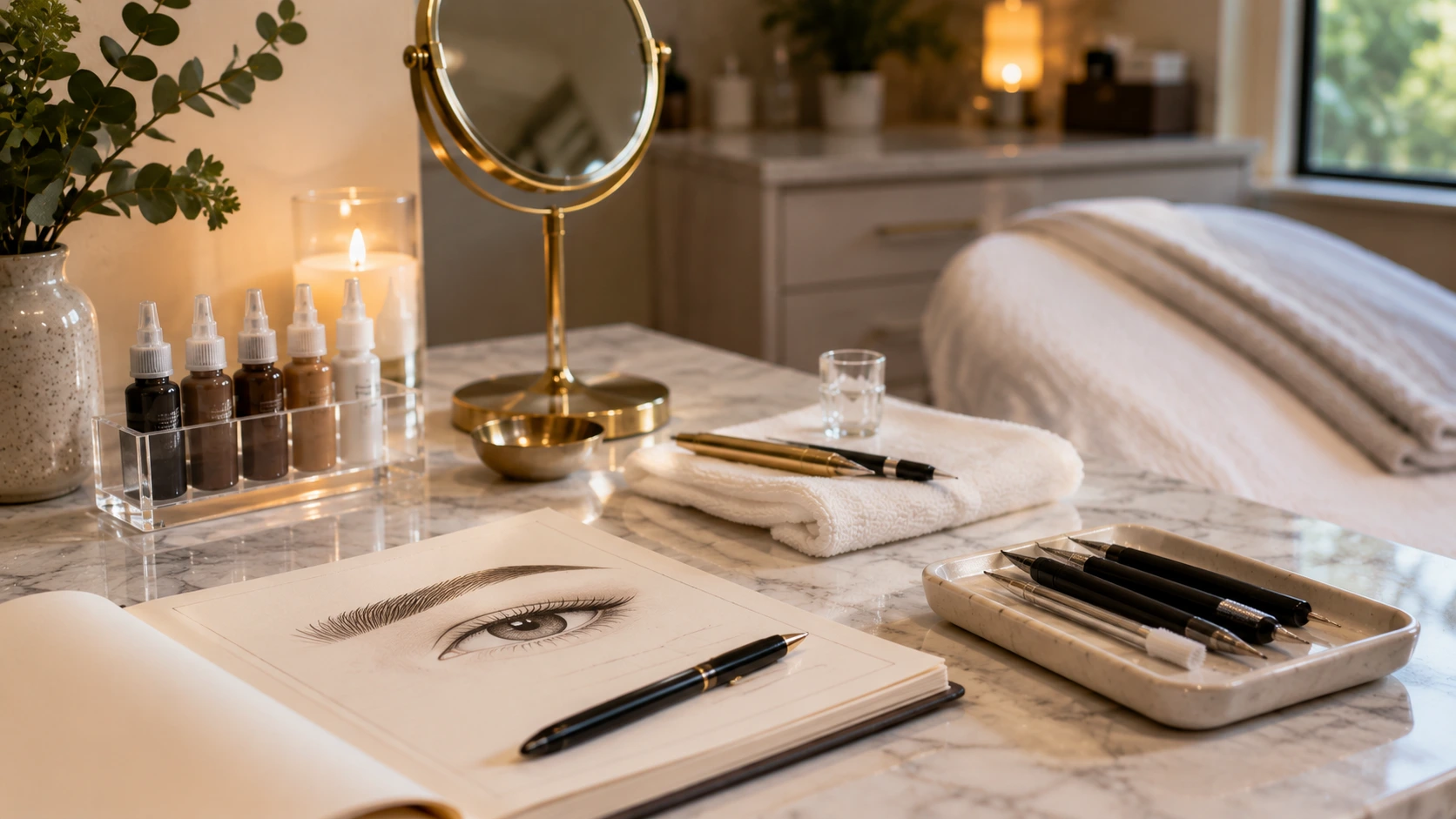
Permanent makeup deposits pigment into the upper layers of your skin to create a consistent, wash-proof foundation for brows, liner, and lips. It saves real time each morning, holds through sweat and water, and removes the daily exposure to fragrances and preservatives that cause reactions in sensitive skin. It’s not the right fit for every situation, and understanding the difference matters before you commit.
Key Takeaways
• Permanent makeup works best when your aesthetic preferences are already settled, not when you’re still experimenting with different looks
• Technique selection depends on your skin type, not just your style preference; the wrong match produces the wrong result
• The upfront investment looks different when you account for what you’re already spending on daily products and application time
• Healing takes time and the final result isn’t immediately visible; a follow-up touch-up refines what the initial procedure establishes
• For women with cosmetic allergies or sensitivities, permanent makeup removes the daily exposure to the ingredients causing the reaction
What Does “Permanent” Actually Mean Here?
Permanent makeup isn’t the same thing as a conventional tattoo. The pigment sits in the upper layers of the skin rather than deeper dermis, which means it fades gradually over time rather than staying fixed. That fading is actually useful. It means the result can be refreshed and adjusted as your face changes and your preferences evolve.
What it can’t do is disappear overnight if you decide you want something different. That’s the starting point for any honest conversation about whether it’s right for you. The commitment is real, and it deserves real consideration before you book.
Who Gets the Most from Permanent Makeup?
Think about the last time you ran late because your brow routine didn’t land right on the first attempt. Not a planned-ahead morning. A random Tuesday when the day was already moving faster than you were.
The women who get the most from permanent makeup tend to share a few specific patterns. Their schedules are genuinely unpredictable, not just occasionally busy. Their skin reacts to conventional cosmetics, whether that’s a fragrance sensitivity, irritation from adhesive residue, or a response to preservatives in gel-based products. And they’ve been applying the same brow shape, the same liner placement, or the same lip definition consistently for a long time without any meaningful desire to change it.
That last point matters more than people expect. Permanent makeup creates a stable baseline. If you rotate between different looks depending on your mood or the season, that stability will feel restrictive. If you’ve drawn the same arch in the same place for years and never thought twice about changing it, the baseline will feel like the obvious solution.
For anyone still exploring what options are available, our services page covers every treatment in one place.
Which Technique Actually Fits Your Skin?
This is where most people hit a wall. The question isn’t which technique looks best on someone else’s face. It’s which one your skin will actually hold correctly over time.
Microblading creates fine, individual hairlike strokes that replicate the look of natural brow hairs. The result reads as remarkably realistic on normal to dry skin. On oilier skin types, the fine stroke definition is more likely to soften as the skin retains moisture closer to the surface, because the oil glands push outward through the dermis and can diffuse narrow pigment deposits over time. This doesn’t mean microblading is a bad technique. It means technique selection has to account for skin biology before a stroke is made, not after.
Microshading deposits pigment in a soft, stippled pattern that produces a filled-in brow rather than individual hair strokes. Because it doesn’t depend on fine line definition, it tends to hold more consistently on oily or combination skin. The result sits within the natural range while reading as more polished than microblading.
Ombre brows use a gradient approach, lighter at the inner brow and gradually deeper toward the tail. This mirrors the way most people fill their brows with powder or pomade, and the broader pigment deposit means it’s generally a more compatible technique across varied skin types. A consultation is the only reliable way to identify which approach, or which combination, fits your specific skin.
At the Hampton Falls clinic, Elizabeth evaluates your facial structure, skin type, existing brow shape, lifestyle, and goals before selecting a technique. She hand-maps each design to your actual features rather than using a stencil. The mapping session is where the result is really decided. The procedure executes on what the mapping defines.
The Honest Cost Picture
Daily makeup isn’t cheap. It just feels that way because the cost spreads across purchases small enough to stop registering. Brow pencils, setting gels, and concealers accumulate into a recurring spend that most people have never added up. Layer in the time spent applying them each morning, including the mornings when you redo the first attempt, and the true cost of the daily routine becomes harder to dismiss.
Permanent makeup carries a higher upfront investment, along with periodic touch-up appointments as the pigment fades over time. When you measure both options across several years and include the time you’d reclaim each morning, the comparison looks different than it does at first glance. Worth reading before you decide: what the benefits of permanent makeup look like in practical terms against daily application laid out side by side.
The cost comparison only appears unfavorable to permanent makeup if you’re comparing it against doing nothing at all. If you’re already spending consistently on daily brow maintenance, the real question isn’t whether to spend. It’s whether the arrangement you have is actually working.
Doing Nothing vs. Moving Forward
| Factor | Staying with Daily Application | Permanent Makeup at Million Dollar Brows |
| Daily time required | Recurring application every morning | Near zero once healing is complete |
| Result consistency | Varies by available time, lighting, and how the morning goes | Consistent regardless of schedule or conditions |
| Allergy and irritation exposure | Ongoing daily contact with fragrances, adhesives, preservatives | Removed; pigment selected with your skin and sensitivity history in mind |
| Sweat and water resistance | Low | High |
| Total cost over time | Lower per transaction, higher when totaled across years | Higher upfront, lower when measured across the same window |
| Healing period required | None | Real; the full result takes time to settle after the initial procedure |
| Flexibility to change your look | Any time | Stable baseline; adjustable at touch-up appointments |
Permanent makeup wins on every factor that matters to a packed schedule. Daily cosmetics hold one real advantage: the ability to change your look whenever you want. If that flexibility is genuinely central to how you use makeup right now, waiting until your preferences are settled is the smarter call. That’s not a reason to avoid permanent makeup. It’s a reason to time it correctly.
What Permanent Makeup Doesn’t Do
This is where trust either builds or it doesn’t.
Permanent makeup creates a foundation, not a complete look. Your brows will be set. Your liner will be placed. But if your full routine includes eyeshadow, contour, or changing lip color daily, you’ll still be completing most of it each morning. The time savings are real and targeted, not total.
It also doesn’t perform identically on every skin type. Mature skin, significantly oily skin, and skin with substantial sun exposure all retain pigment differently. The procedure establishes the initial result. How your individual skin holds the pigment as months pass determines the longevity, and no practitioner can fully override your biology on that front. Honest timelines require an honest skin assessment first.
And it doesn’t resolve an underlying uncertainty about what you want. If you’re still experimenting with different shapes or styles, a consultation is the right first step. Elizabeth builds that conversation into every appointment before any technique is selected or any pigment is used. For lower-commitment starting points that still deliver a visible difference, eyebrow tinting and eyelash enhancement are worth considering first.
Three Questions to Ask Before You Book
Consider this before making a decision.
Have you been applying the same feature in the same way for a sustained period without wanting to change it?
Would skipping that step on an unplanned morning genuinely affect how you feel leaving the house?
Is the application itself the problem, or is it that you’re not yet happy with the result you’re getting from it?
Yes to the first two and no to the third means permanent makeup is solving the right problem.
No to the first means your preferences aren’t settled enough yet. If the third question is what’s actually driving the frustration, that’s exactly the kind of thing a consultation resolves before any commitment is made.
FAQ
How long does healing actually take?
The surface skin typically closes within roughly two weeks, during which brows appear darker and may shed lightly as the top layer cycles through. The deeper result continues settling after that point. A follow-up touch-up appointment refines the final outcome and addresses any areas where pigment retention was uneven. Because everyone’s skin heals differently, exact timelines aren’t something any practitioner can promise in advance, but the touch-up appointment exists specifically to account for that variation.
Will it look natural, or will it be obvious?
Natural results come from technique selection and facial mapping, not from the procedure alone. When the shape is designed around your actual bone structure and the pigment is matched to your natural hair color and skin tone, the result reads as your features at their best rather than something applied on top of them. That’s why hand-mapping happens before a single stroke is made. The art and science behind a well-executed eyebrow result explains the rationale in more depth.
I have oily skin. Is microblading still an option?
On oily skin, microblading’s fine hairlike strokes are more likely to lose definition over time because the skin’s natural oil production pushes outward through the dermis and can diffuse narrow pigment deposits. Microshading or ombre brows use broader pigment deposits rather than precise line work, which makes them more compatible with oily skin. A consultation identifies which approach suits your specific skin before any commitment is made.
What happens if I’m unhappy with the result?
Because permanent makeup fades over time, an unsatisfactory result isn’t necessarily permanent. Pigment can also be addressed through saline removal or laser treatment, though those are separate procedures with their own considerations. The better answer is preventing the problem in the first place, which is what a thorough consultation, clear communication about your goals, and careful facial mapping are designed to do. Elizabeth’s process starts with that conversation, every time.
Is it safe if I have sensitive skin or cosmetic allergies?
For many women who react to conventional cosmetics, permanent makeup removes the daily exposure to fragrances, adhesives, and preservatives that trigger most reactions. Pigment selection matters, and Elizabeth reviews your allergy and sensitivity history before recommending specific products. She’s licensed and certified in New Hampshire, has completed 1,500 hours of apprenticeship as required by New Hampshire law, and has performed over 1,000 procedures, including work with clients who have sensitivities to conventional cosmetics. You can also explore what PMU is and how it differs from traditional makeup for a fuller picture of how the products and process compare.
How often do touch-ups come up, and what does the long-term cost look like?
Permanent makeup fades at different rates depending on skin type, sun exposure, and the technique used. Oily skin and consistent sun exposure both accelerate fading. Touch-up appointments are less involved than the original procedure and priced accordingly. When touch-up costs are included in a multi-year comparison against ongoing daily product purchases and the time spent applying them, permanent makeup holds up as a practical alternative for women whose routines have been stable for years.
How uncomfortable is the procedure?
Most people describe the sensation as light pressure or surface scratching rather than sharp pain. A topical numbing cream is applied before the procedure, which reduces discomfort significantly for most clients. Sensitivity varies by person and by treatment area. Brow procedures are generally more comfortable than lip or eyeliner work, though the numbing protocol applies across all of them. A pre-appointment consultation gives you the chance to ask specific questions about what to expect before the day of your appointment.
You’ve been running the same morning routine for years. At some point the question stops being whether permanent makeup is worth considering and starts being why you’re still running the same routine when a better option is available.
Elizabeth sees clients Monday through Saturday, 9 AM to 4 PM, at 87 Lafayette Road Unit 9, Hampton Falls, NH. She serves clients across New Hampshire, Maine, Massachusetts, Connecticut, New York, and Rhode Island. Book a consultation at Million Dollar Brows and find out which technique fits your skin, your schedule, and the look you actually want.
About the Author
Elizabeth is the founder and lead artist at Million Dollar Brows, a permanent makeup clinic in Hampton Falls, NH. She has over ten years of experience in the beauty industry, holds a New Hampshire state license and certification, and completed 1,500 hours of apprenticeship as required by New Hampshire law. She has performed over 1,000 procedures specializing in microblading, microshading, ombre brows, eyeliner, and lips, with a practice built on personalized facial mapping and technique selection to deliver natural-looking results for every client.