
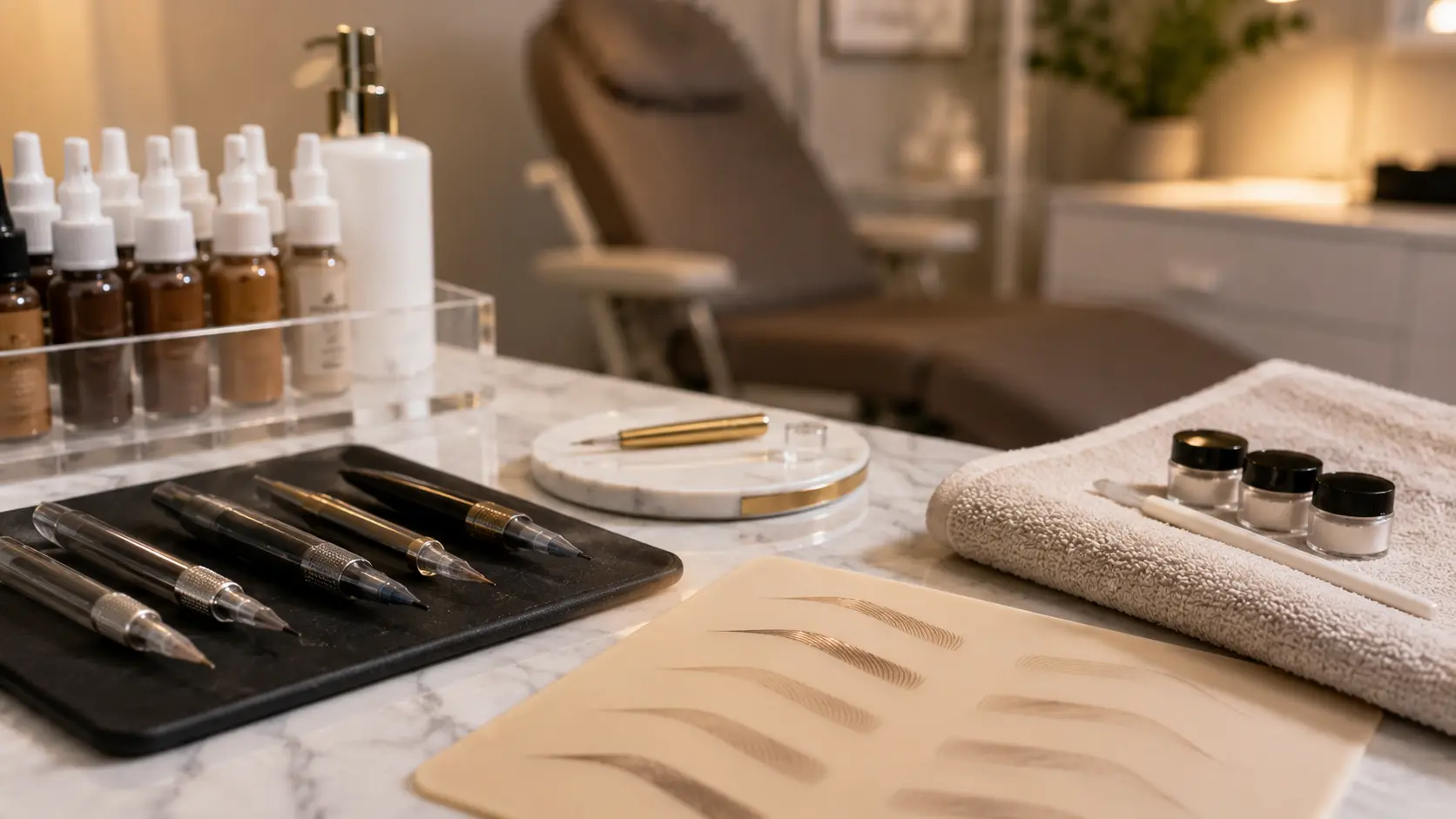
Every morning involves the same quiet negotiation: how much time can you actually spare before the day gets away from you? For a lot of women, that negotiation ends with rushed brows, skipped steps, and the low-grade frustration of knowing something as small as a pencil is still running the clock.
Direct Answer
Scalp micropigmentation and permanent cosmetics both deposit pigment into skin, but they serve entirely different purposes. Scalp micropigmentation targets the scalp to simulate hair follicles for people experiencing thinning or hair loss. Permanent cosmetics works on facial features including brows, eyeliner, and lips. If your concern is your face, permanent cosmetics is the category you need.
Key Takeaways
• Scalp micropigmentation and permanent cosmetics share the same root technology but require distinct training, pigment formulations, and depth calibration for each area
• Microblading, microshading, and ombre brows are all subcategories of permanent cosmetics, and each one performs differently depending on your skin type
• Technique selection should follow a proper skin and structure assessment, because the wrong fit for your skin produces results that won’t hold the way you’d expect
• A hand-mapped design built around your actual facial structure reads as your own features refined, not as obvious permanent makeup
• The real cost of waiting isn’t zero: it’s every morning between now and when you decide you’re done negotiating with the routine
What Is Scalp Micropigmentation, and Why Do People Get Confused?
Scalp micropigmentation places tiny pigment deposits into the scalp to create the visual impression of individual hair follicles. It serves people dealing with thinning hair, receding hairlines, or visible scalp through existing hair.
Permanent cosmetics is a broader category: pigment applied to facial features to replicate or enhance the appearance of makeup. Both fall under the umbrella term “micropigmentation,” which describes the mechanism of placing pigment into skin rather than the application area or the technique. That shared vocabulary is where most of the confusion starts.
These techniques aren’t interchangeable. Scalp skin behaves differently than the thinner, more mobile skin around your eyes and brows. Depth calibration, pressure, needle configuration, and pigment selection all have to be approached differently depending on where you’re working. A practitioner trained in scalp work isn’t automatically qualified in facial permanent cosmetics, and the reverse is equally true. The overlap in terminology doesn’t translate into overlap in skill.
Conflating the two when you’re choosing a provider is one of the more consequential mistakes you can make.
Which Brow Technique Actually Fits Your Skin?
This is where the real decision happens, and it deserves serious attention because the answer depends on your skin, not on which result looks best in a photo.
Eyebrow microblading uses a manual blade to create fine, hairlike strokes that mimic individual brow hairs. On the right candidate, it produces realistic eyebrows with hairlike strokes that hold cleanly over time. The phrase “right candidate” carries real weight here. Skin type plays a meaningful role in how fine pigment channels heal and retain definition. Because the strokes are narrow and precise, they depend on the skin stabilizing around them in a particular way during healing. This is why technique selection can’t happen without a proper skin assessment first. What works beautifully for one client may underperform for another, not because microblading is a flawed technique, but because it’s a specific one. The fit matters.
Microshading uses a stippling method to build a soft, powdered effect rather than individual strokes. Because the pigment is distributed more broadly rather than concentrated in fine channels, it suits women who prefer a filled-in brow over drawn-in hairs. Ombre brows combine both approaches: the front of the brow stays lighter and softer, deepening gradually toward the tail. Many clients find the gradient reads as particularly natural-looking because it loosely mirrors the variation in density typical of unaltered brows, though the most flattering result depends on your facial structure and what you’re trying to achieve.
Consider a common situation. Someone wants something natural-looking but defined enough that no additional product is ever needed on top. The right starting technique for that goal depends on how their specific skin heals and holds pigment over the full recovery period. That kind of distinction only becomes clear after a real skin evaluation, which is exactly why the consultation comes before any technique decision at Million Dollar Brows. If you want to understand how manual and machine-based brow techniques compare at a technical level, that breakdown is worth reading alongside this one.
Why Permanent Cosmetics Keeps Working When Daily Makeup Doesn’t
Think through the pencils, powders, and gels you’ve replaced over the last few years. Then add the time. Not just the minutes per application in isolation, but the cumulative hours across a year of mornings when you were already behind and already negotiating with everything else on the list. Fine isn’t the same as effortless. You’ve been managing this every single day.
The case for permanent makeup over daily application comes down to removing a daily variable you’ve been managing so long it stopped feeling like a choice. It became part of the morning.
For women with cosmetic sensitivities, there’s an additional dimension worth considering. Daily brow products involve repeated, consistent contact with the skin surface, and for women who find that daily product use is uncomfortable or unreliable because of how their skin responds, eliminating that routine contact is worth noting. That said, permanent cosmetics use pigment that does enter the skin, so if you have a documented allergy history or known sensitivities, a detailed consultation and patch test must happen before any procedure. That’s not optional. Be upfront about your history so Elizabeth can assess the fit properly.
Acting vs. Waiting: What the Real Tradeoff Looks Like
The table below compares two situations: continuing the daily routine versus booking a consultation at Million Dollar Brows. It’s not a comparison between service tiers. It’s a comparison between doing something about the problem and continuing to work around it.
| What You’re Weighing | Continuing the Daily Routine | Booking a Consultation at Million Dollar Brows |
| Time spent on brows each morning | Every day, indefinitely | Eliminated after healing |
| Consistency of results | Varies with time, tiredness, and schedule | Consistent regardless of how your morning goes |
| Skin sensitivity concerns | Ongoing daily contact with products that may be irritating | Single application with a consultation and patch test first for sensitive-skin clients |
| Design approach | You decide from scratch every morning | Hand-mapped to your facial structure by Elizabeth before any pigment is applied |
| Investment timing | Small amounts continuously, with no endpoint | Upfront, with a touch-up included and periodic refresh as needed |
| Risk of poor outcome | Products can be wiped off, but the cumulative time and frustration still accumulate | Technique and artist selection both matter, which is why the consultation and Elizabeth’s experience are the non-negotiable starting point |
The cost of waiting isn’t zero. It’s every morning between now and whenever you finally decide you’re done negotiating with the routine.
What Permanent Cosmetics Can’t Do
Permanent cosmetics won’t replicate the density or texture of actual hair. If significant brow hair loss is your concern, particularly loss connected to a medical condition, a conversation with a dermatologist belongs before any pigment service. Pigment can fill visual gaps and create the appearance of fuller brows, but it works with what’s structurally present.
It also can’t correct poor facial symmetry on its own. What it can do is work with your natural facial structure to create visual balance, but only when the design is mapped to your specific features rather than applied from a template.
Elizabeth hand-maps every design to each client’s actual facial structure before any pigment is applied. No stencils. This matters because a stencil applies the same shape to every face, which is why so much permanent makeup reads as permanent makeup rather than as someone’s own features, refined.
The word “permanent” means the pigment doesn’t wash off. It doesn’t mean it lasts indefinitely. Skin naturally exfoliates over time, and pigment fades with it. Sun exposure accelerates that process because UV exposure speeds the breakdown of pigment in the upper skin layers where the color sits. A touch-up after initial healing is a standard part of the process at Million Dollar Brows. Periodic refresh appointments are how clients maintain their results over the long term.
You can’t wash this off if you change your mind. That’s why the consultation, the artist’s experience, and the technique selection all have to come first. Anyone offering to skip those steps is offering you the wrong thing.
Who’s the Strongest Fit for a Consultation?
The fit is strongest when at least one of these applies:
• You fill in your brows, line your eyes, or apply lip color every day and would keep doing it regardless of how much time you had
• You have cosmetic sensitivities that make daily makeup uncomfortable or unreliable
• Your schedule doesn’t support a consistent morning routine and you’ve accepted that as a fixed constraint
• You have previous permanent makeup that has faded, migrated, or no longer reflects what you want
• You want a result that requires no additional product layered on top
The fit is weaker if you’re still experimenting with your preferred brow shape or lip color. The full range of services available works best when you know what you want and want it reliably. If you’re still deciding, that’s exactly the conversation to have during a consultation before committing to anything.
Elizabeth has over ten years in the beauty industry, holds her New Hampshire state license, and completed the full 1,500-hour apprenticeship the state requires. She’s performed over 1,000 procedures, specializing in eyebrow microblading, microshading, ombre brows, eyeliner, and lips. That’s not a credential to skim past. It’s what produces the difference between an artist who has worked through how different skin types respond across the full healing cycle and one who hasn’t.
Booking a consultation at the Hampton Falls clinic is the right place to start if you want your skin type, facial structure, and goals all evaluated before any technique is selected. Elizabeth is available Monday through Saturday and serves clients across New Hampshire, Maine, Massachusetts, Connecticut, New York, and Rhode Island.
Frequently Asked Questions
Is scalp micropigmentation the same thing as microblading?
No. Scalp micropigmentation places pigment into the scalp to simulate hair follicles for people experiencing thinning or hair loss. Microblading places pigment into brow skin using a manual blade to create hairlike strokes. The techniques, needle types, required depth, and pigment formulations are all different. Training in one area doesn’t qualify an artist to perform the other.
How long does permanent eyebrow makeup last before a refresh is needed?
Longevity varies depending on your skin type, sun exposure, the skincare products you use, and how closely you follow aftercare instructions. Factors that accelerate cell turnover in the upper skin layers where pigment sits will shorten how long the color holds. A touch-up after initial healing is a standard part of the process at Million Dollar Brows, and periodic refresh appointments are how clients maintain their results over time.
Will permanent brows look natural or obviously done?
That depends almost entirely on whether the design is mapped to your specific facial structure. Results that look artificial typically come from stencil-based approaches that apply the same shape to every client regardless of their features. Hand-mapped brows built around your natural bone structure and existing brow shape look like your own brows, just better defined.
I have sensitive skin and react to some makeup products. Is permanent cosmetics an option for me?
Possibly, yes. For women who experience discomfort or unreliable results from daily product use, eliminating that repeated daily contact with the skin surface is worth exploring. That said, permanent cosmetics does involve pigment entering the skin, so if you have a documented allergy history, a patch test and thorough consultation about your specific sensitivities must happen before any procedure. Be upfront about your history during the consultation so Elizabeth can assess the fit properly.
What’s the real difference between microblading and ombre brows?
Microblading creates individual hairlike strokes using a manual blade, relying on fine pigment channels in the skin to hold the definition over time. Ombre brows build a gradient effect, lighter at the front of the brow and deeper toward the tail, with pigment distributed more broadly across the treatment area. How each technique performs for you depends on your specific skin and how it heals. A proper consultation will tell you which option your skin can reliably hold.
Can I get permanent cosmetics if I’ve had previous microblading I don’t like?
Sometimes, yes. It depends on how much pigment remains, how it has healed, and what a corrected result needs to look like. Work that has faded significantly is generally easier to address than work that’s still saturated or has migrated. A consultation is the only way to assess what’s realistically possible. Don’t book a correction procedure without having that conversation first.
Does the procedure hurt?
Most clients describe the sensation as mild discomfort rather than pain. A topical numbing agent is applied before the procedure begins, which significantly reduces sensation. Individual tolerance differs, and the sensitivity of the treatment area varies depending on which service you’re having. The procedure is well-tolerated by most clients.
Elizabeth is the founder and lead artist at Million Dollar Brows, located at 87 Lafayette Road Unit 9, Hampton Falls, New Hampshire. She holds her New Hampshire state license, has completed the 1,500-hour apprenticeship required by state law, and has performed more than 1,000 procedures across more than ten years in the beauty industry. She specializes in eyebrow microblading, microshading, ombre brows, eyeliner, and lips, and also offers eyelash extensions, lash lifts, and lash tints. Million Dollar Brows serves clients across New Hampshire, Maine, Massachusetts, Connecticut, New York, and Rhode Island.