
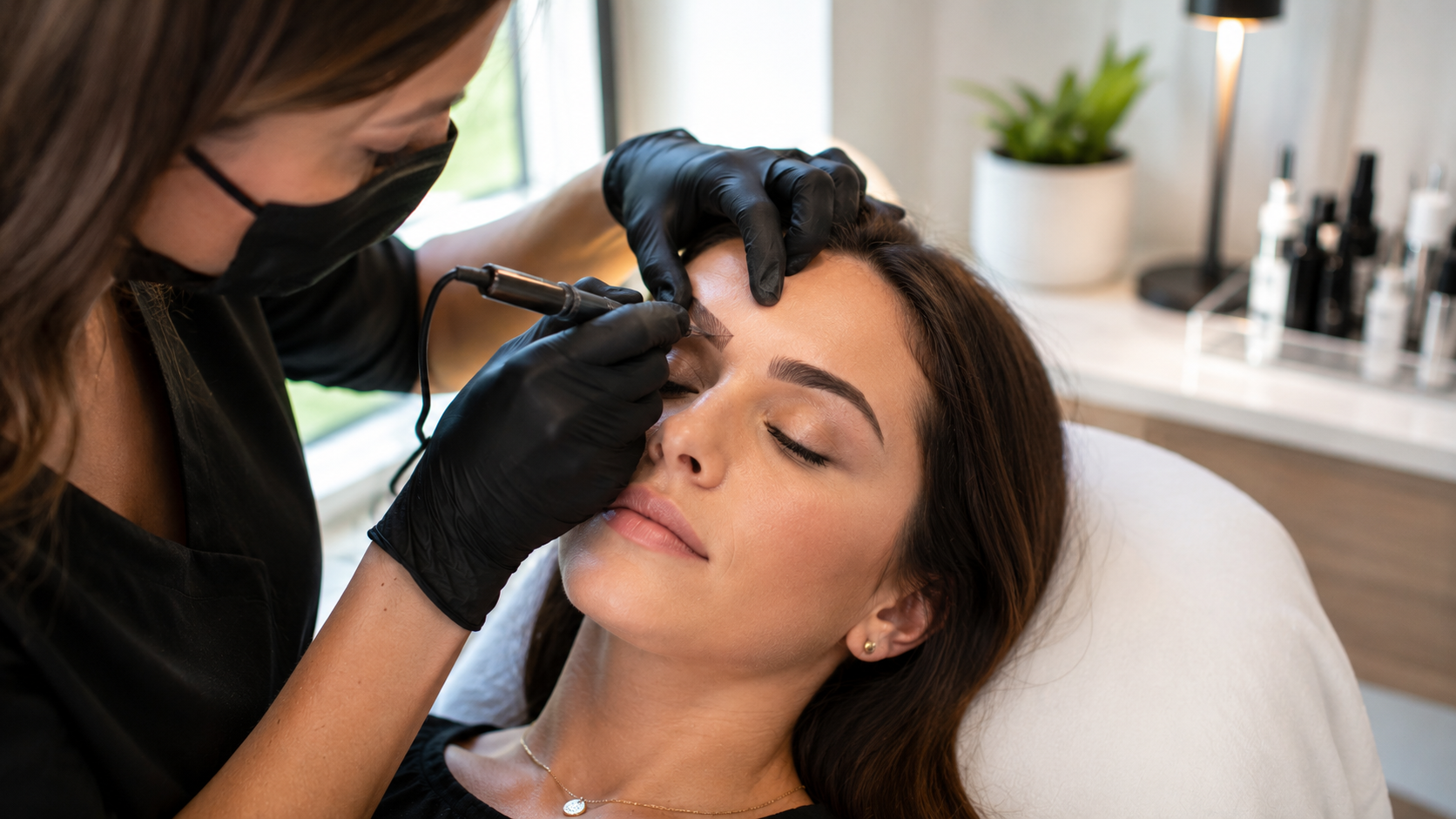
By Elizabeth, Million Dollar Brows
Your brows are the first thing people read on your face – and research from the Department of Brain and Cognitive Sciences at MIT confirms it’s your eyebrows, not your eyes, that are most critical to facial recognition and emotional expression. That one fact changes how you should think about every brow option in front of you.
Permanent makeup isn’t the right choice for everyone. But for most busy women who’ve spent years fighting with pencils, powders, and patchy growth, it’s not really a beauty decision – it’s a time decision.
Direct Answer
Microblading and other permanent makeup options outperform daily brow products when consistency, time savings, and allergy avoidance matter most. Daily makeup works for low-maintenance needs or temporary looks, but it can’t survive sweat, swimming, or a packed schedule. Permanent options require upfront investment and a healing period, but deliver results that hold for one to five years with minimal daily effort.
Key Takeaways
- Microblading uses fine hairlike strokes to create realistic brows that can last up to five years with proper care (Studio Sashiko, cited in ELLE, 2023)
- Daily brow products require reapplication, smudge in heat and humidity, and can trigger reactions in women with cosmetic allergies
- The healing window for microblading runs 10-14 days – plan around it, don’t ignore it
- Ombre powder brows suit oilier skin better than microblading; the right technique depends on your skin type, not just your aesthetic preference
- The real cost of doing nothing is measured in minutes per day, every day, for years
Why Does Choosing a Brow Solution Feel So Complicated?
The options aren’t the problem. The framing is.
Most brow content positions microblading as the “premium” choice and pencils as the “budget” choice, as if the decision is purely financial. That framing misses what’s actually at stake. You’re not choosing between expensive and cheap. You’re choosing between a daily task that compounds over time and a one-time procedure that removes that task entirely.
A typical case: a professional woman spending eight minutes each morning on brows – filling, blending, fixing, checking. Over a year, that’s nearly 49 hours. Over five years, it’s close to 245 hours. The pencil isn’t cheaper. It just spreads the cost in small enough increments that it never feels like a cost at all.
The daily makeup habit feels free because you pay for it in time, not money – and time doesn’t show up on a credit card statement.
What’s Actually Causing the Confusion Around Permanent Makeup?
The gap between what you read online and what actually happens in the chair is exactly where confusion lives – and that gap exists for a specific reason: most content conflates technique with outcome, and outcome with longevity.
Microblading is a semi-permanent tattooing technique that uses a hand-held blade to deposit pigment in fine, hair-mimicking strokes just below the skin’s surface. That’s the definition. What it doesn’t tell you is that how long those strokes hold depends almost entirely on your skin’s behavior – oil production, sun exposure, skincare routines, and how your body metabolizes pigment.
This is the part most guides skip: pigment retention is not primarily a procedure problem – it is a skin behavior problem. Two women can receive identical microblading sessions from the same artist and see noticeably different results at the 18-month mark. One has dry skin, minimal sun exposure, and avoids retinol. The other has combination skin, runs outdoors, and uses active skincare. Same procedure. Different skin. Different outcome.
That’s not a failure. That’s biology.
The Brow Decision Matrix: Which Option Actually Fits Your Life?
The Brow Decision Matrix is a framework for matching brow enhancement options to your actual lifestyle conditions – not your aesthetic preferences alone.
Use it by identifying which column describes your daily reality most accurately.
| Condition | Daily Brow Products | Microblading | Ombre Powder Brows |
| Skin type | Works on all types | Best for normal to dry skin | Better for oily or combination skin |
| Time commitment | 5-15 min daily, indefinitely | One session + 6-week touch-up, then annual or biannual | Same as microblading |
| Sweat/water resistance | Low – smudges easily | High once fully healed | High once fully healed |
| Cosmetic allergies | High risk – daily exposure to pigments, waxes, preservatives | Low ongoing risk after healing | Low ongoing risk after healing |
| Cost structure | Low upfront, high cumulative | Higher upfront (typically starting around $900, per ELLE, 2023) | Similar to microblading |
| Longevity | Zero – reapply daily | Up to 5 years with proper care | Up to 5 years with proper care |
| Ideal for | Occasional wear, changing looks | Sparse brows, hair-stroke realism | Defined, filled look; oilier skin types |
The matrix doesn’t declare a winner. It identifies fit. Your skin type alone can eliminate one option before you even discuss aesthetics.
What Does the Healing Process Actually Look Like?
This is the follow-up question most people have after they understand how microblading works – and it’s the one that determines whether someone books or walks away.
The healing process takes 10-14 days. In the first few days, brows look darker and more defined than the final result. Around days four through seven, the surface skin begins to flake and the color appears to lighten – sometimes dramatically. This is normal. The pigment is settling into the deeper skin layer, and what you see on the surface isn’t the finished result.
By day 14, most of the surface healing is complete. The six-week touch-up appointment exists precisely because the final result only becomes visible once healing is done. Skipping that appointment is one of the most common reasons women are disappointed with their outcome – not the initial session, but the missing follow-through.
Plan the procedure around your schedule. If you have a major event, a beach trip, or a week of outdoor workouts in the next two weeks, push the appointment. The healing window isn’t optional.
You can explore the full range of permanent makeup services at Million Dollar Brows to understand what’s involved before you book.
Does Microblading Work for Everyone?
No. And saying so plainly is more useful than a list of disclaimers.
Microblading isn’t the right technique for oily skin types. The oil breaks down the pigment faster, blurs the hairlike strokes over time, and produces a softer, less defined result than what most clients expect. For oily skin, ombre powder brows – which use a stippling technique rather than blade strokes – hold better and look more consistent over time. The ombre powder brows technique at Million Dollar Brows is specifically designed for clients where microblading alone wouldn’t hold.
Microblading also isn’t appropriate for:
- Skin that’s actively breaking out or inflamed in the brow area
- Women who are pregnant or nursing
- Anyone on blood thinners or certain acne medications (a consultation will clarify this)
- Women expecting zero maintenance – a touch-up is part of the process, not optional
This isn’t a reason to avoid permanent makeup. It’s a reason to have an honest consultation before you commit to a specific technique. The right technique for your skin is the one that actually lasts.
What About Lash Extensions – Are They in the Same Category?
They’re related but different. Lash extensions and lash lifts solve the same morning-routine problem for your eyes that microblading solves for your brows – they remove a daily task.
A lash lift reshapes your natural lashes from the root, creating the appearance of length and curl without extensions. It lasts six to eight weeks and requires no daily mascara. Lash extensions add individual synthetic lashes to your natural ones and last three to four weeks before a fill is needed.
Neither is permanent in the way microblading is, but both eliminate the daily mascara step – which matters if you’re running, swimming, or simply don’t want to think about it. The eyelash services at Million Dollar Brows cover both options for women who want to address the full picture, not just brows.
Limitations Worth Knowing Before You Book
Permanent makeup fades. That’s not a flaw – it’s a feature. The semi-permanent nature means mistakes aren’t forever, and styles can evolve. But it does mean you’re committing to maintenance, not a one-time fix.
Sun exposure is the fastest way to accelerate fading. SPF on the brow area is non-negotiable for longevity. Retinol and exfoliating acids also break down pigment faster – if your skincare routine includes active ingredients, your results will fade sooner than someone who doesn’t use them.
Permanent makeup also can’t create brows where there’s no hair follicle activity at all – it pigments skin, not stimulates growth. For women with complete brow loss, it creates the appearance of brows, which is meaningful. But it doesn’t change the underlying condition.
FAQ
How much does microblading cost and is it worth it?
Microblading typically starts around $900, according to ELLE’s 2023 guide, and varies by location and artist experience. Whether it’s worth it depends on how much time you spend on brows daily and how long you plan to maintain it – over three to five years, the per-day cost is often lower than a quality brow pencil habit.
Will microblading look natural or will it look drawn on?
When done correctly, microblading uses hairlike strokes that mimic real brow hairs – the result should look like your brows, just better. The “drawn on” look comes from poor technique or the wrong style choice for your face shape, not from the procedure itself.
How long does microblading last?
With proper care, microbladed brows can last up to five years. In practice, most people find the color starts to soften around 12-18 months and schedule a touch-up then. Your skin type, sun exposure, and skincare routine all affect how quickly the pigment fades.
Does microblading hurt?
Most clients describe it as a mild scratching sensation rather than pain. A topical numbing cream is applied before the procedure, which significantly reduces discomfort. Sensitivity varies by person, but it’s rarely described as a reason not to do it.
Can I get microblading if I have sensitive skin or cosmetic allergies?
Cosmetic allergies are actually one of the strongest reasons to consider microblading – it eliminates daily exposure to the pigments, preservatives, and waxes in conventional brow products. A patch test and honest consultation before booking will identify any concerns with the pigment used.
What’s the difference between microblading and ombre powder brows?
Microblading creates individual hairlike strokes for a natural, textured look. Ombre powder brows use a stippling technique that produces a softer, more filled-in appearance – similar to brow powder. Oily skin types generally hold powder brows better because the technique is less affected by excess oil production.
How do I know if I need a touch-up or a full new session?
If the shape and overall placement still look right but the color has faded, a touch-up is usually enough. If the strokes have blurred significantly, the shape has shifted, or it’s been more than two years, a fuller refresh session gives better results. Your artist can assess this at a consultation.
Stop Spending 8 Minutes a Day on a Problem You Can Solve Once
If you’ve read this far, you’re not casually curious – you’re genuinely weighing whether this is the right move. That’s exactly the right place to be.
The next step isn’t research. It’s a conversation. Book a consultation at Million Dollar Brows in Hampton Falls, NH – open Monday through Saturday, with online and phone booking available. Bring your questions about your skin type, your schedule, and what you actually want your brows to look like. That’s what the consultation is for.
About the Author
Elizabeth is the founder of Million Dollar Brows and a licensed permanent makeup specialist in the state of New Hampshire. She has completed over 1,000 procedures and holds specialized training in microblading, microshading, ombre brows, eyeliner, and lip pigmentation across multiple states. New Hampshire law requires body art artists to complete 1,500 hours of apprenticeship – Elizabeth meets and exceeds that standard.
References
ELLE – microblading cost, healing timeline, and longevity data
MIT Department of Brain and Cognitive Sciences – eyebrows and facial/emotional recognition