
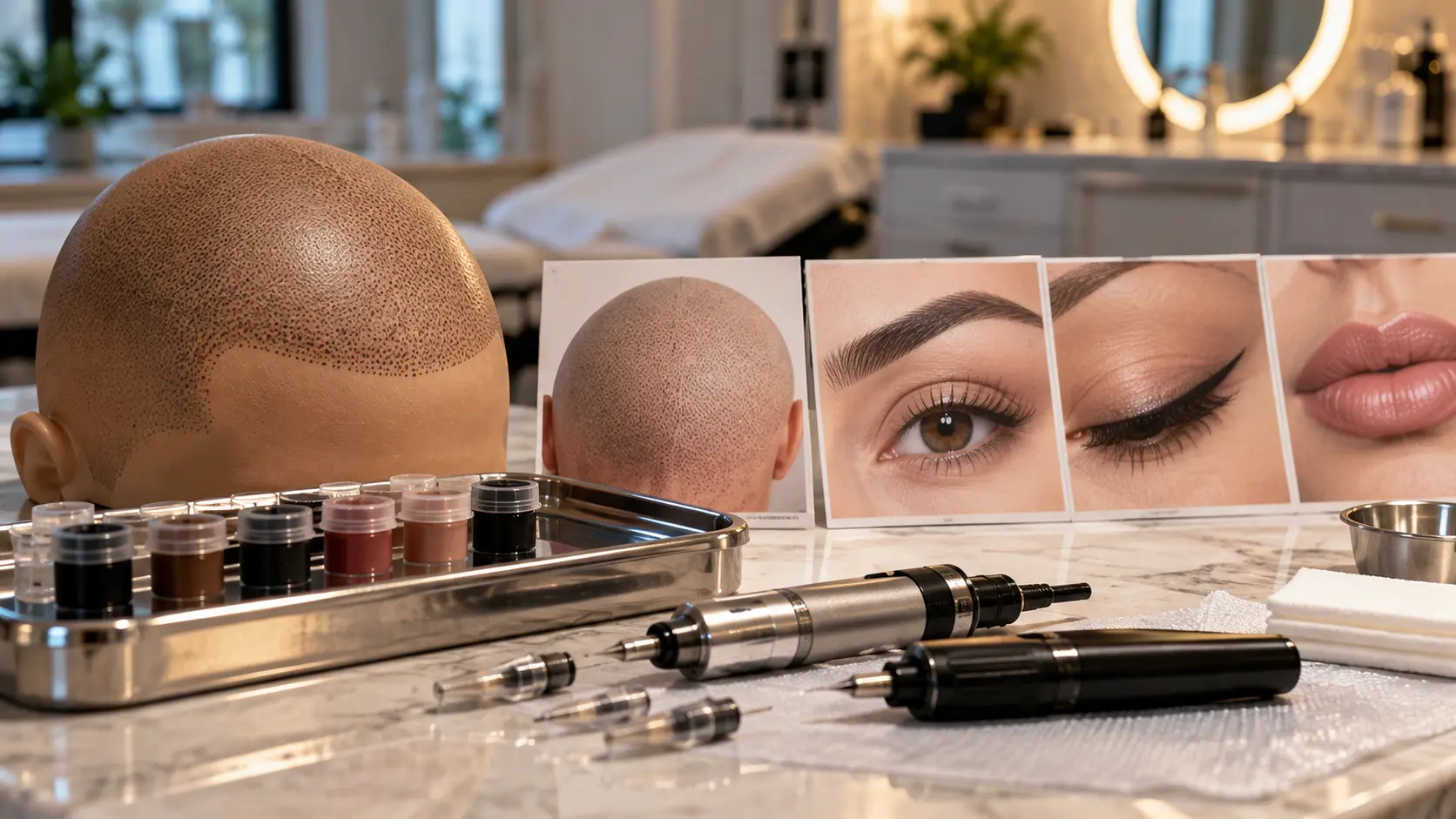
Scalp micropigmentation and permanent cosmetics are both forms of cosmetic tattooing, but they’re built for different surfaces, different concerns, and different visual outcomes. Booking the wrong one doesn’t just produce a disappointing result. It produces a result that’s harder and more expensive to correct than the original concern ever was.
Key Takeaways
- Scalp micropigmentation replicates follicle dots on the scalp. Permanent cosmetics create strokes, gradients, and shaped definition on facial features. These are visually and technically different outcomes.
- SMP pigment is formulated to maintain contrast on the scalp. Permanent cosmetics pigment is selected to integrate with your skin’s undertone. Using the wrong formulation on the wrong surface shows.
- For brows, lash lines, and lip color, permanent cosmetics procedures are calibrated to your actual facial anatomy in a way SMP simply isn’t designed to be.
- The technique choice is decided before any pigment touches your skin, which means the consultation matters more than most people expect.
- Waiting or going with an unqualified provider compounds the problem. The cost of fixing a poor result typically outweighs the cost of doing it correctly the first time.
What Problem Are You Actually Solving?
Most people don’t start their search with a technical name. They start with a concern: brows that disappear by midday, a lash line that takes ten minutes to draw on, lips that lost their definition years ago. Then a search result hands them a procedure name, and they run with it without confirming it fits the concern.
Scalp micropigmentation addresses two specific things well. It creates the visual impression of follicle density on a thinning scalp, and it rebuilds a defined hairline edge where the original has receded. The technique deposits layered pigment dots into the scalp, calibrated to simulate closely cropped hair at normal viewing distance. That’s a precise and effective solution for scalp concerns.
It’s not designed for facial feature work.
When someone with sparse brows or faded lip color lands on SMP in their search results and books it as a workaround, the outcome reflects the mismatch. Not because SMP failed, but because it was never the right tool for that surface. The needle configuration, the pigment depth, the pigment formulation, and the artistic approach for facial skin are all different from what SMP requires. Recognizing that difference before booking is the step that saves you from a correction that costs more than the original procedure did.
Why Does the Confusion Keep Happening?
Search results group “permanent makeup” and “scalp micropigmentation” as though they’re subcategories of the same thing. They’re not. They’re distinct disciplines with separate training requirements, separate pigment chemistry, and different healing behaviors.
Here’s the specific reason this confusion produces real problems: SMP pigment is typically formulated to hold its cool tone as it fades. That’s intentional, because the goal on a scalp is to contrast with surrounding skin. Permanent cosmetics pigment for facial features is selected to work with your skin’s undertone, because the goal is integration, not contrast. A pigment that’s right for the scalp will read as off-color in the brow area as it settles. The surface didn’t cause that. The pigment choice did.
This is also why technique and formulation knowledge aren’t separable. A practitioner who does both well understands not just the physical difference between the procedures, but how each one heals across different skin types and complexions. That’s the judgment that protects your result.
What Each Option Actually Delivers
The table below isn’t a ranking. It’s a practical map of which technique fits which concern, and what happens when the decision gets deferred.
| Your Situation | Approach | What It Delivers | What It Doesn’t Do |
|---|---|---|---|
| Thinning scalp or receded hairline | Scalp micropigmentation | Simulates follicle density; defines hairline edges | Doesn’t add real hair; requires periodic touch-ups as pigment fades |
| Sparse or uneven brows | Microblading or nano brows with Million Dollar Brows | Hairlike strokes mapped to your facial structure; shape decided once and done correctly | Fades faster on oily skin without microshading added |
| Little to no natural brow hair | Ombré powder brows with Million Dollar Brows | Soft gradient that holds well across most skin types; daily fill-in gone | Slightly more defined than a bare-skin brow; less suited to a completely “barely there” look |
| Undefined or invisible lash line | Permanent eyeliner with Million Dollar Brows | Depth and definition without daily liner application | Permanent; style changes require laser removal |
| Faded or uneven lip color | Lip blushing with Million Dollar Brows | Restores natural color and definition; color is always there | Doesn’t add volume; color heals lighter than it looks immediately after the procedure |
| Waiting, delaying, or skipping qualified help | Doing nothing or using an unqualified provider | No upfront cost | Daily routine continues; the concern compounds; a correction appointment later costs significantly more than the original procedure would have |
If you’re weighing specific brow techniques against each other, the detailed breakdown of ombré powder brows versus microblading covers the skin-type factors that most people don’t think about until after they’ve already committed.
Why Permanent Cosmetics Works for Facial Features When SMP Doesn’t
Permanent cosmetics is cosmetic tattooing calibrated specifically for facial skin, covering brows, lash lines, and lips. Facial skin is more reactive than scalp, more expressive, and far more visible at close range. It also fades pigment at a rate that varies based on skin type, sun exposure, and individual body chemistry. That variability is exactly why technique selection and the judgment behind it matters.
Consider a situation that comes up often: someone with naturally sparse brows has been drawing them on from scratch every morning for years. The shape shifts day to day depending on time, lighting, and how steady their hand is. Done well, permanent brow work removes that variable entirely. The shape is decided once, correctly, and it’s there when they wake up.
At Million Dollar Brows, Elizabeth freehands every design directly to each client’s facial anatomy. No stencils. That distinction carries real weight because a stencil produces a shape that looks symmetrical in isolation. Your face isn’t flat, and a shape that works on a template can sit differently on your actual bone structure. The mapping process is where the result is actually decided, and it happens before any pigment touches your skin.
Elizabeth is licensed and certified in New Hampshire, has completed the 1,500 hours of apprenticeship required by state law, and has performed over 1,000 procedures across brows, eyeliner, and lips. That volume of hands-on work builds a specific kind of judgment you can’t acquire from coursework alone: the ability to read how a particular skin type will heal and adjust the technique before that happens, rather than after. She’s also attended workshops and conferences across multiple states, which means the depth of perspective she brings isn’t limited to a single training environment.
You can review the full range of services at Million Dollar Brows if you want to see what’s available before scheduling.
How to Figure Out Which Category Actually Fits Your Concern
Start with one question: is the area you want to address covered by hair, or is it a facial feature you see directly in the mirror?
If it’s scalp coverage or a hairline in an area where hair grows or used to grow, scalp micropigmentation is the right category. If it’s brows, lash lines, or lips, you’re in permanent cosmetics territory. That’s the filter that eliminates most of the confusion before it becomes a booking mistake.
Where it gets more layered is when both concerns exist at once. Someone dealing with sparse brows and some hairline thinning might feel like both apply. In that case, start with whichever concern is affecting your daily routine more. The procedures can coexist, but healing from one affects how your face looks while the other is still fresh. Staggering them is the smarter sequence, and a proper consultation is where that timeline gets sorted out.
The honest overview of whether permanent makeup is right for you covers the conditions that make it a strong fit and the ones where waiting makes more sense.
When Permanent Makeup Isn’t the Right Move Yet
Permanent makeup isn’t appropriate if you’re in the middle of a significant health change that affects your skin. Hormonal shifts, certain medications, and active skin conditions all influence how pigment heals and retains. A procedure done during that window may not produce the result it should, and redoing it costs more than waiting would have.
It’s also not the right fit if you’re uncertain about shape or technique going into the appointment. The consultation is where the real decision happens. If that uncertainty isn’t resolved before the procedure starts, it won’t resolve itself on the table.
And scalp micropigmentation specifically isn’t a substitute for brow work. SMP produces follicle dots. Brow techniques produce strokes, gradients, and shaped definition. Those are visually different outcomes for a visually different surface. If you want to think through the broader landscape of options before deciding, the permanent makeup vs. alternatives comparison lays out the tradeoffs clearly.
For anyone also weighing lash options alongside brow work, the breakdown of lash lift versus extensions versus mascara is worth reading before you commit to a direction.
Ready to stop managing the same concern every morning? Contact Million Dollar Brows to schedule a consultation that starts with your face, not a service menu.
Frequently Asked Questions
How is scalp micropigmentation different from microblading?
SMP deposits small pigment dots into the scalp to simulate the look of closely cropped follicles. Microblading creates fine, hairlike strokes in the brow area using a different needle configuration and pigment formulated for facial skin. Both are forms of cosmetic tattooing, but they’re designed for different surfaces and produce visually different results. Using one in place of the other doesn’t produce a hybrid result. It produces the wrong result.
Can SMP be used to fill in sparse eyebrows?
No. SMP produces a dotted, follicle-like pattern that reads naturally on a scalp but reads as visually off in the brow area, where the expectation is defined by strokes or soft shading. Microblading, nano brows, or ombré powder brows are the appropriate techniques for brow concerns.
How long does permanent brow work typically last?
Most permanent brow techniques require a touch-up somewhere between one and three years after the initial procedure, depending on skin type, sun exposure, and how your body processes pigment. Oilier skin tends to fade faster because sebum production accelerates pigment breakdown at the surface. A follow-up touch-up after the initial healing period is standard practice and is how the final result gets refined.
Does the consultation actually matter, or is it mostly a formality?
The consultation is where the result is decided. Facial mapping, skin type assessment, technique selection, and color matching all happen before any pigment is applied. A practitioner who skips real assessment or relies on stencils rather than freehand mapping increases the risk that the shape won’t suit your actual facial structure. The quality of the consultation is one of the clearest signals of what the outcome will be.
I react to most conventional makeup products. Can I still consider permanent makeup?
Sensitivity to conventional makeup is one of the most common reasons people seek permanent cosmetics. Because the pigment is deposited beneath the surface rather than sitting on top of the skin, the daily irritation from topical products is removed from the equation. That said, a thorough consultation is important to assess compatibility with your specific skin before proceeding.
What’s the difference between microblading and nano brows?
Microblading uses a manual blade to create hairlike strokes. Nano brows use a machine with a single needle to deposit pigment in a similar stroke pattern, but with more precision and typically better retention on oily or mature skin. The visual result can look nearly identical, but nano brows tend to hold longer on skin types where microblading fades quickly. Which one is right for you depends on your skin type, which is part of what gets assessed during the consultation.
Is it safe to have multiple permanent makeup areas done at the same session?
In some cases, yes. It depends on how much surface area is involved and how your body handles the healing process. Healing from one area while another is still fresh can affect the outcome of both. The right answer depends on your specific situation and gets determined during the consultation rather than in advance.
About the Author
Elizabeth is the founder of Million Dollar Brows, a permanent makeup clinic in New Hampshire. She’s licensed and certified in the state of New Hampshire, has completed over 1,500 hours of apprenticeship as required by New Hampshire law, and has performed over 1,000 procedures specializing in microblading, microshading, ombré brows, eyeliner, and lips. With over 10 years in the beauty industry, Elizabeth has attended workshops and conferences across New Hampshire, Maine, Massachusetts, Connecticut, New York, Florida, and California. She approaches every procedure freehand, without stencils, to ensure results that suit each client’s individual facial structure. Million Dollar Brows serves clients across New Hampshire, Maine, Massachusetts, Connecticut, New York, and Rhode Island.