
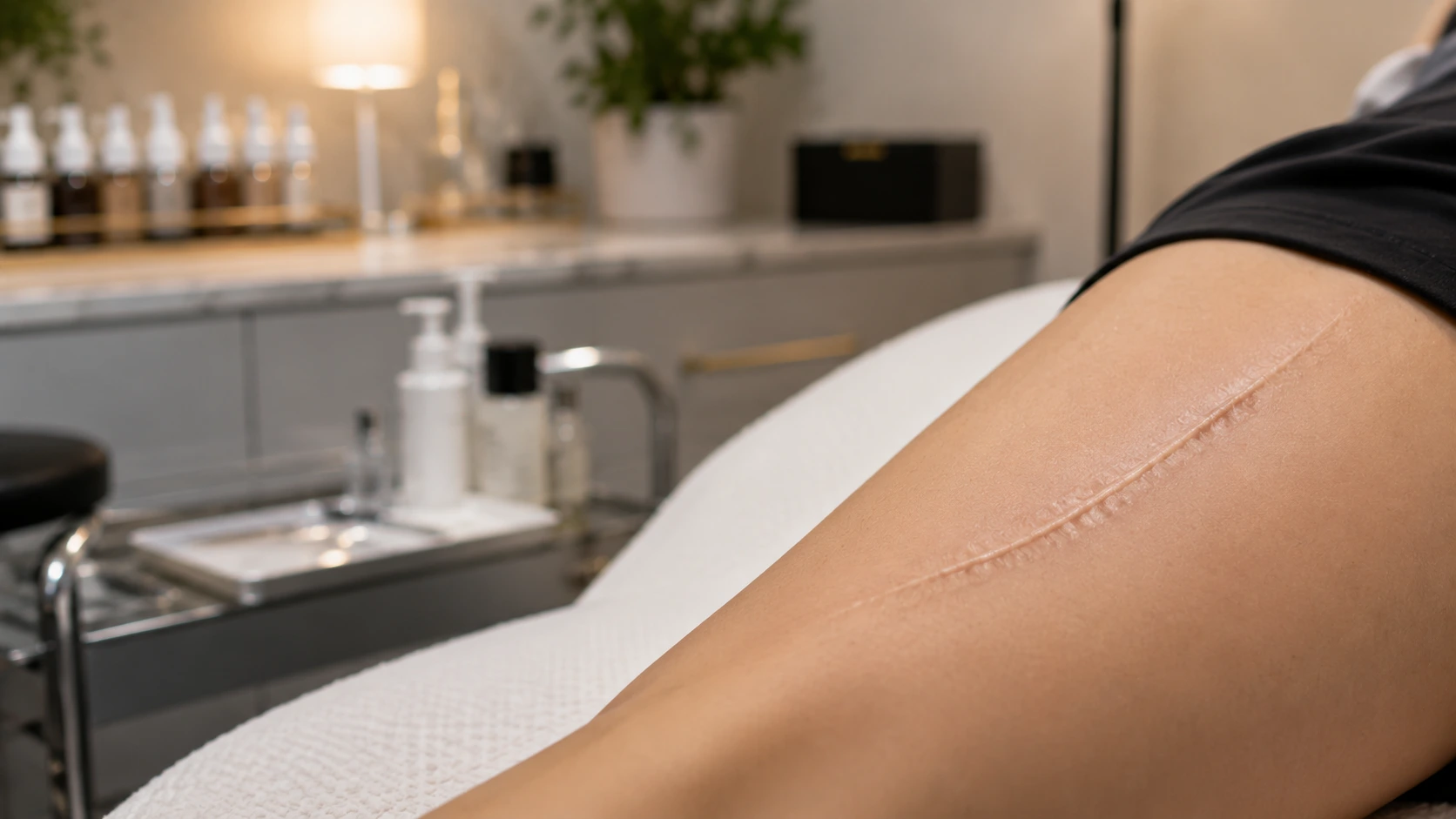
Skin and scar camouflage uses flesh-tone pigments tattooed into scar tissue to reduce the visual contrast between the treated area and surrounding skin. It doesn’t erase the scar. Strong results mean the area no longer draws the eye. Getting there requires the right scar characteristics, the right timing, and a technician who understands how damaged tissue absorbs pigment differently than healthy skin.
Key Takeaways
- Scar camouflage deposits pigment into scar tissue to reduce visual contrast, not to recreate normal skin.
- Pigment retention in scar tissue is less predictable than in healthy skin, so multiple sessions are normal and expected.
- Scar age, texture, depth, and location each shape the result more than any single session can.
- Going to a technician without specific scar tissue experience is the most common reason results fall short.
- Waiting until a scar is fully stable protects your investment rather than delaying it.
What Is Scar Camouflage and How Does It Work?
The procedure involves depositing flesh-tone pigments at the correct depth in the dermis to reduce the color contrast between scar tissue and the surrounding skin. It’s used for surgical scars, burn scars, stretch marks, hypopigmentation from trauma, and scars from skin conditions or medical procedures including mastectomies.
What separates this from standard cosmetic tattooing is the tissue itself. Scar tissue has a different cellular structure, a reduced blood supply, and uneven porosity compared to healthy skin. That means pigment doesn’t absorb at a predictable, even rate. It also means the color can shift during healing in ways that wouldn’t happen on undamaged skin.
This isn’t a complication. It’s the baseline reality of working with compromised tissue, and any technician who doesn’t account for it from the first consultation is already behind.
The same disciplines that drive quality outcomes in eyebrow microblading apply here: color theory, skin depth assessment, and understanding how tissue type changes the way pigment sets and holds. The canvas is different. The underlying skill set overlaps significantly.
What Do Strong Results Look Like?
You stop reaching for the concealer before you leave the house. Not because someone told you the scar is gone, but because you genuinely stopped thinking about it.
That’s the target outcome. The scar is still there if you look closely in good light. But it no longer reads as the thing the eye goes to first. The color match is close enough that it blends rather than contrasts.
That outcome is achievable for many people. It’s not guaranteed, and it rarely arrives in a single session.
Strong results don’t mean invisible. They mean the scar reads as a slight skin variation rather than a feature you’re actively managing. That’s a meaningful shift, and for most people, it’s exactly enough.
What Actually Drives the Result?
Results come from two directions: what you bring to the treatment, and what the technician brings to it.
On your side, the biggest factors are scar age, texture, skin tone, and location on the body. Scars need to be at least 12 months old and fully stable before camouflage begins. A scar that’s still changing color or texture isn’t finished healing, and pigment deposited into actively changing tissue will shift unpredictably as the skin continues to mature.
Texture matters because pigment addresses color contrast, not surface irregularity. A flat scar responds significantly better than a raised or indented one because the surface catches and reflects light the same way as the surrounding skin. A textured scar still scatters light differently regardless of how well the color matches.
Location matters because areas with constant movement, sun exposure, or friction fade faster. A scar on the forearm will need more consistent upkeep than one on the torso.
On the technician’s side, the critical skill is color-matching for compromised tissue. This isn’t the same as color selection for cosmetic tattooing on healthy skin. The technician has to anticipate how the pigment will shift during healing, how the scar tissue’s porosity will affect absorption, and how the surrounding skin tone behaves across different lighting conditions. Getting the color formula wrong at the consultation means every session afterward is correcting that original miscalculation.
This is also why safety protocols specific to permanent makeup carry more weight with scar tissue than with healthy skin. The margin for error is smaller because the tissue is already compromised and responds differently to trauma.
What’s the Realistic Timeline?
Most scar camouflage cases involve two to four sessions, spaced eight to twelve weeks apart. Some cases take more. Very few are complete after one.
The reason comes down to biology. The first session reveals how the tissue responds to pigment. You can’t fully predict that until you’ve seen the healed result. The second session fills in gaps and builds evenness. By the third, you’re typically refining a result rather than rebuilding it from scratch.
To illustrate what a typical progression might look like: imagine a fully healed, relatively flat surgical scar on a medium skin tone. After a first session, coverage would likely be visible but uneven in places because scar tissue absorbs pigment at different rates across the surface. A second session would typically address that unevenness. A third session would be about refinement and color precision. The total timeline from first session to final result could reasonably span six months or more. That scenario isn’t meant to predict your specific outcome. It’s meant to show that the multi-session process is the normal path, not a sign that something went wrong.
Your skin decides how much pigment it holds and how evenly it distributes it. The procedure creates the starting point. Healing refines it from there.
Scar Camouflage vs. Daily Concealer: The Honest Comparison
Most people think concealers are cheaper. That’s only true if you don’t count the daily time, the product cost that accumulates month after month, or the fact that concealer has a ceiling it can’t get past.
| Daily time required | 5 to 15 minutes, every single day | None after healing is complete |
| Works through sweat and water | No | Yes |
| Result in all lighting conditions | Inconsistent | Consistent reduction in visual contrast |
| Cost over multiple years | Accumulates continuously | Single investment with periodic touch-ups |
| Emotional load | Constant awareness and daily management | Significantly reduced once healed |
| Risk of skin reactions | Ongoing daily exposure to products | Limited to the procedure period |
Daily concealer isn’t a cheaper solution. It’s the same cost spread thin enough that it never registers as a cost. Scar camouflage is a one-time investment that stops that clock.
If you’re already using permanent makeup services to reduce your daily routine, scar camouflage follows the same logic. You’re buying back the time and attention you’ve been spending on the same problem every morning.
Who Gets the Best Results, and When Should Someone Wait?
Scar camouflage works best on scars that are fully healed and stable, relatively flat, located in a low-friction and low-sun area, and on skin that hasn’t recently been treated with retinoids, chemical peels, or laser procedures.
It works less well, or requires significantly more sessions, on raised scars, scars that are still maturing, or scars in areas that are difficult to protect from sun exposure after treatment.
Waiting when a scar isn’t ready isn’t a delay. It’s protecting the outcome. Pigment placed into tissue that’s still changing will shift in ways that require correction, which means more sessions and more cost down the road.
People with keloid scarring history need a careful consultation before proceeding. Keloid-prone skin can respond to tattooing by producing additional scar tissue, which is the opposite of the intended result. Certain autoimmune conditions and active skin conditions in the treatment area also require evaluation before booking.
This is exactly why the consultation isn’t a formality at Million Dollar Brows. It’s the first and most important step. Elizabeth has completed over 1,000 procedures and 1,500 hours of apprenticeship required by New Hampshire’s licensing standards. Every treatment begins with a personalized assessment of skin type, scar characteristics, and the client’s specific goals before any technique or session plan is discussed.
What Separates a Technician Who Should Do This from One Who Shouldn’t?
Ask specifically about scar tissue experience. Not general permanent cosmetics experience. Not before-and-after photos alone. Ask how they handle uneven absorption after the first session. Ask how they adjust color formulas when the healed result shifts differently than expected.
A technician trained only in standard microblading and semi-permanent makeup doesn’t automatically have the knowledge to work with compromised tissue. The techniques share a foundation. The tissue behavior doesn’t.
The challenges involved in the permanent makeup profession are real, and scar camouflage sits toward the harder end of that spectrum. The skill floor is higher, and the consequences of getting color theory wrong on damaged tissue are harder to correct than a standard cosmetic procedure.
Confidence in the consultation room isn’t the same as competence with scar tissue. Those questions will tell you the difference.
FAQ
How do I know if my scar is ready for camouflage?
The clearest sign is that the scar has stopped changing in color and texture. That process typically takes at least 12 months after the original injury or surgery. If it’s still pink, red, or shifting in appearance, waiting protects your result. A qualified technician will assess scar stability at your consultation rather than booking you immediately.
Will it look natural, or will people notice something was done?
A good result looks like a skin variation, not a tattooed area. The goal is reducing visual contrast so the scar doesn’t draw the eye, not creating a perfect replica of undamaged skin. How natural the final result looks depends on your skin tone, the scar’s texture, and how many sessions you complete.
Does it hurt more because it’s scar tissue?
Scar tissue has different nerve distribution than healthy skin, and sensitivity varies depending on the cause and location of the scar. Some people find scar tissue less sensitive than the surrounding area. Others find it more so. A topical numbing agent is typically used, and you should discuss comfort management with your technician before the session begins.
How long will results last before a touch-up is needed?
Pigment in scar tissue tends to fade faster than pigment in healthy skin because the structural differences in scar tissue affect how color is held over time. Sun exposure, skincare products, and individual skin behavior all affect the timeline. Your technician can give you a more specific expectation based on your scar’s characteristics and location.
What if the color doesn’t match perfectly after the first session?
Uneven absorption and slight color shifts after the first session are normal. That’s part of what the second session is designed to address. A technician with genuine scar tissue experience plans for this from the start and won’t present a single session as the finished result.
Can scar camouflage be done anywhere on the body?
Technically yes, but location significantly affects how long results last. Areas with constant movement, friction, or regular sun exposure fade faster and may require more frequent touch-ups. Protecting treated areas from direct sun during and after healing is important for maintaining the result.
What should I avoid before and after a session?
Before your appointment, avoid retinoids, chemical exfoliants, and direct sun exposure on the treatment area for at least two weeks. After your session, keep the area clean, avoid submerging it in water, and stay out of direct sun during healing. Your technician will give you specific aftercare instructions based on your scar’s location and your skin type.
Ready to find out whether your scar is a good candidate and what realistic results look like for your situation? Million Dollar Brows is open Monday through Saturday at 87 Lafayette Road, Unit 9, Hampton Falls, NH. Book online or call to schedule your consultation.
About the Author
Elizabeth is the founder and lead permanent makeup artist at Million Dollar Brows in Hampton Falls, New Hampshire. She holds her New Hampshire license and certification, has completed over 1,000 procedures and 1,500 hours of apprenticeship, and has worked in the beauty industry for over a decade. Services are available to clients across New Hampshire, Maine, Massachusetts, Connecticut, New York, and Rhode Island.