
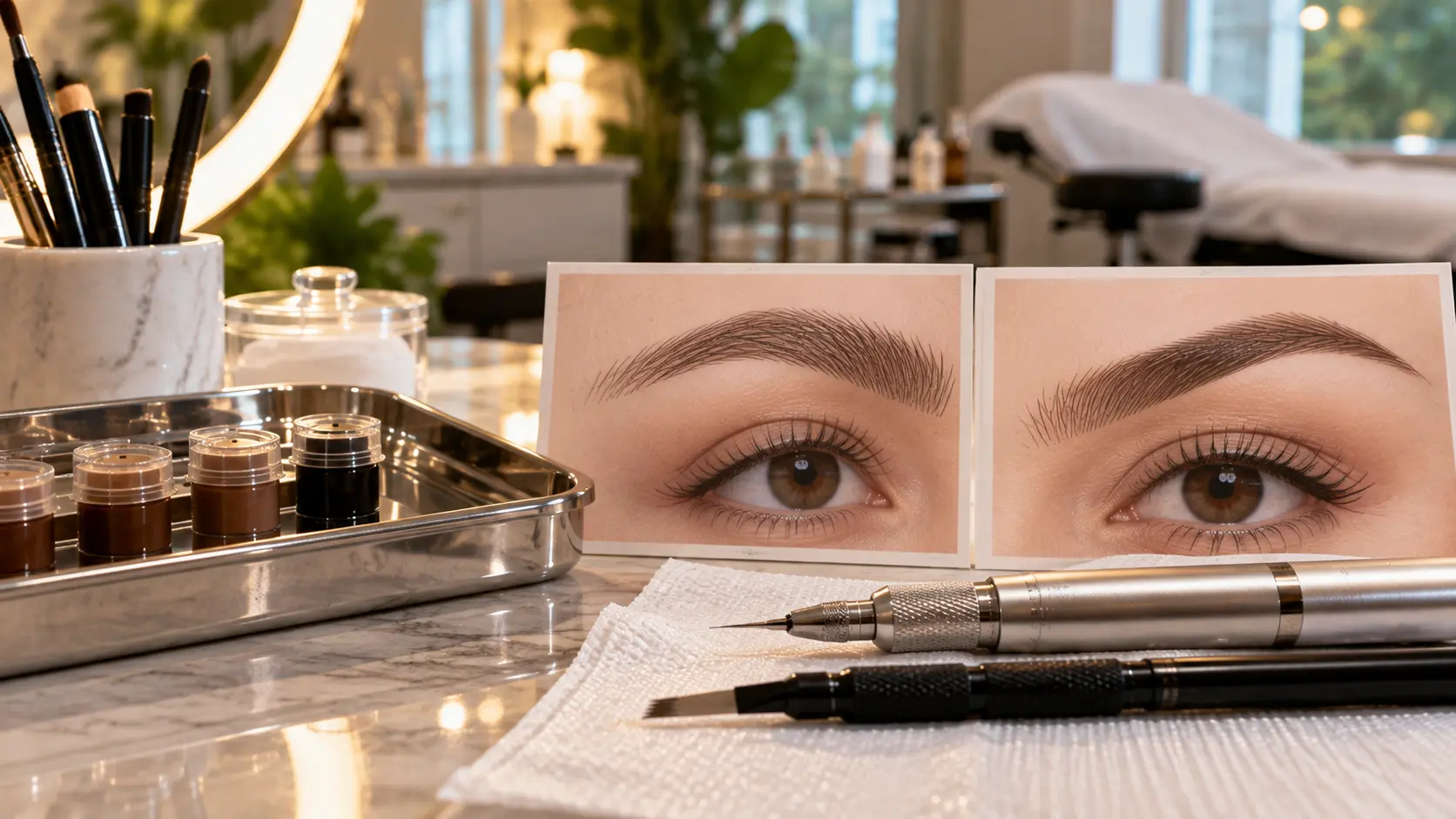
Nano brows and microblading both build realistic, hair-like strokes using pigment deposited into the skin. The tool is different, the tissue response is different, and on certain skin types, the outcome is meaningfully different. Knowing which technique fits your skin before you book protects your investment and your brows.
Key Takeaways
- Microblading uses a hand-held blade to create fine incisions; nano brows use a single needle on a digital machine to tap pigment in without a lateral cut.
- Dry to normal skin with good elasticity tends to respond well to microblading; oily and mature skin types generally hold nano brow strokes more reliably over time.
- Neither technique is universally better. Skin type, healing patterns, and touch-up commitment all factor into which one serves you.
- Combination brows (hair strokes paired with soft shading) often outperform either technique alone on borderline skin types.
- A hands-on consultation with brow mapping and skin assessment before any procedure is the only way to avoid choosing a technique your skin will work against.
What Actually Makes These Two Techniques Different?
The names suggest a minor variation. The mechanics are not minor.
Microblading is a manual technique. A small, multi-tipped blade creates fine incisions just into the upper dermis. Pigment is pressed into those cuts to simulate individual brow hairs. When the skin type is right, the result is strikingly natural.
Nano brows use a digital machine fitted with a single ultra-fine needle. Instead of cutting, the needle taps pigment into the skin in precise, controlled strokes. There is no lateral incision, only a series of punctures.
Here is the distinction that carries real weight in practice: microblading breaks the skin surface along a line; nano brows puncture it at a point. That difference shapes how surrounding tissue responds during healing, how pigment behaves once it is placed, and how long the result holds on different skin types.
For a fuller picture of how hair stroke brows compare to other permanent makeup approaches, the honest tradeoff guide to permanent makeup vs. the alternatives is a useful read before you commit to anything.
Which Skin Types Actually Benefit From Each?
This is where the real conversation starts, and where marketing copy tends to go quiet.
Microblading performs at its strongest on dry to normal skin with good elasticity. The incisions stay defined, pigment settles into crisp strokes, and the healed result holds close to what you see in the days after the procedure. Tighter-pored, firm skin responds predictably to the technique.
Oily skin changes that picture. Sebum in the upper skin layers works against microblading because the incision, as it heals, gives pigment more opportunity to spread slightly outward. What started as a defined hair stroke can soften over time into something closer to a smudge. That is not a practitioner error; it is a skin response no level of technical skill can fully override.
Mature skin presents a similar challenge. Reduced collagen density and looser texture mean incisions are less likely to hold their shape cleanly through the healing process.
Nano brows handle both of these situations better, and the reason is mechanical. The tapping motion creates a smaller, more contained wound than a blade incision. From Elizabeth’s clinical experience, that more contained wound site tends to produce less surrounding tissue disruption, which means the pigment is less likely to migrate laterally as the skin heals. On oily skin, that is a practical, real-world advantage. On mature skin, it is often the only hair stroke approach that delivers a result worth the investment.
To understand how hair stroke brows specifically compare to powder-style techniques on oily and combination skin, the ombré powder brows vs. microblading comparison covers that decision directly.
Does One Technique Last Longer?
Generally, nano brows hold their definition longer on oily and mature skin, and the reasoning is specific rather than vague.
A blade incision involves more lateral tissue disruption than a needle puncture does. More disruption tends to trigger a more active healing response. An active healing response increases the chance that pigment shifts slightly from where it was placed, and that shift is what blurs a stroke over time. On dry, firm skin with a predictable healing response, that process is more controlled, and microblading in skilled hands can produce initial crispness that holds well.
On oily or mature skin, the gap between the two techniques tends to widen after the first six to twelve months. The strokes that came out beautifully right after the procedure begin to soften faster because the skin type was working against the technique from the start.
That said, no permanent makeup technique is truly permanent. Sun exposure, individual cell turnover rate, and your body’s own healing behavior all affect longevity. The care you give your brows in the first two weeks after the procedure carries as much weight as the technique itself.
The Option Most People Forget to Ask About
Here is a framing worth reconsidering: for a lot of people, the nano brows versus microblading question is actually the wrong question.
A combination approach, meaning hair strokes through the brow body paired with a soft powder shading fill, often produces a more natural and more durable result than either technique alone. The strokes give definition and dimension. The shading fills gaps, anchors the color between visits, and compensates for any stroke softening that occurs over time on borderline skin.
Combination brows take more time and require a higher level of skill. That is probably why they are underrecommended. But if you are investing in something you will wear every day for the next year or two, the additional time in the chair is not a compelling reason to settle for a technique that is a partial fit for your skin.
At Million Dollar Brows, Elizabeth maps each brow design by hand to your actual facial structure, without stencils, before any technique choice is finalized. That means the conversation about what will actually work for your skin happens before pigment touches it, not after.
Nano Brows vs. Microblading: A Direct Comparison
| Factor | Booking a qualified consultation and matching technique to your skin | Choosing a technique based on trend, price, or availability without a skin assessment |
|---|---|---|
| Technique selection | Matched to your skin type, healing profile, and aesthetic goals | Based on what you saw on someone else’s feed |
| Stroke definition at 12 months | Optimized for how your skin behaves during healing | Unpredictable, technique may work against your skin type |
| Pigment placement | Controlled depth appropriate for semi-permanent results | Inconsistent depth risks premature fading or scarring |
| Correction options | Planned around how your skin takes and holds pigment | Costly and limited if the original work was misplaced |
| Follow-up touch-up | Standard after healing to refine the final result | Often unavailable or not offered |
| Long-term cost | One well-chosen procedure that holds and flatters | Possible correction work to fix a technique that was wrong for your skin |
The wrong technique on the right skin type, executed perfectly, still produces a result you will not be satisfied with. That is the actual cost of skipping a proper consultation. The upfront investment is not the expensive part. The correction is.
Who Should Reconsider Hair Strokes Entirely?
Some clients are not strong candidates for either technique, regardless of which tool is used.
If your skin is very oily and you are not realistic about keeping up with a regular touch-up schedule, powder or ombré brows will serve you better. Strokes tend to soften on oily skin over time. That is a predictable outcome, not a worst-case scenario.
If you have a history of keloid scarring, both techniques involve some skin trauma and carry meaningful risk. Microblading, which involves surface incisions, is the higher concern, but any skin trauma can trigger an atypical healing response.
If you are pregnant or nursing, Elizabeth at Million Dollar Brows will ask you to wait.
If you are currently using retinoids or blood thinners, timing matters before you proceed. Retinoids affect how skin heals and how it retains pigment. Going ahead without adjusting your routine first compromises the final result in ways that cannot be easily corrected.
The article on seven things that actually determine whether microblading looks real covers candidacy factors in detail, including specifics most people do not think to raise before booking.
For anyone still weighing whether permanent makeup is the right direction at all, this honest overview of whether permanent makeup is right for you walks through the real decision factors without a sales pitch attached.
Three Questions to Work Through Before You Book
What is your skin type? Dry or normal skin with good elasticity makes microblading a reasonable starting point. Oily, combination, or mature skin points toward nano brows as the more reliable choice.
How realistic is your touch-up schedule? If your calendar is consistent and you can commit to returning roughly every twelve to eighteen months, microblading on suitable skin can hold up well. If your schedule is unpredictable and you want more runway between visits, nano brows typically give you that.
Are you open to combination work? Sparse brows or noticeable asymmetry respond better to a strokes-plus-shading approach. Dense brows needing subtle definition may do fine with strokes alone.
Work through those three questions honestly before you sit down with anyone. Then use the consultation to refine that starting point with someone who can actually look at your skin.
Elizabeth has performed over 1,000 procedures, holds her New Hampshire state license, and completed the 1,500 hours of apprenticeship required by the state. She has attended workshops and conferences across multiple states and brings that depth to every in-person evaluation. She free-hands all brow work without stencils, mapping each design to your facial structure before any technique is selected.
View our full range of brow and permanent makeup services and book a consultation before your schedule fills in. Million Dollar Brows is open Monday through Saturday and offers both online and phone booking.
FAQ
How do I know if my skin is too oily for microblading?
If your skin looks shiny within a few hours of washing your face, or you blot throughout the day, oily skin is likely a factor. Visible large pores and a tendency toward congestion are additional signals. A practitioner can assess this properly during a consultation, but nano brows are typically the more reliable starting point for oily skin types.
Will nano brows look as natural as microblading?
Yes, when performed by a skilled practitioner. A single needle on a digital machine can create hair strokes just as fine and realistic as blade-cut strokes. On many skin types, those strokes hold their definition better over time. How natural the result looks depends more on the artist’s mapping, eye, and technique than on which tool was used.
Does nano brow treatment hurt more or less than microblading?
Most people find nano brows slightly more comfortable. The tapping motion creates less surface trauma than blade incisions. Topical numbing is used for both procedures, so discomfort is generally manageable. Individual tolerance varies, and the practitioner’s technique has a real effect on the experience.
How long does healing take for nano brows?
The initial phase, where brows may appear darker, slightly textured, or uneven, typically lasts around ten to fourteen days. Full pigment settling takes closer to four to six weeks. A follow-up touch-up after full healing is standard practice and lets the practitioner refine the result once the skin has stabilized.
Can I get nano brows if I already have old microblading?
In many cases, yes. Nano brows can often be placed over faded microblading to refresh and redefine the strokes. Heavily saturated or unevenly healed prior work needs careful evaluation before new pigment is placed on top. An in-person consultation is the only way to assess this accurately.
What is the difference between nano brows and a traditional eyebrow tattoo?
A traditional eyebrow tattoo deposits ink deeper into the dermis, producing a solid filled shape that does not mimic individual hairs. Nano brows deposit semi-permanent pigment at a shallower depth through a single needle, creating fine hair-like strokes that fade naturally over time. The placement depth, pigment formulation, and visual result are all meaningfully different.
How do I find a qualified nano brow or microblading provider in New England?
Look for a practitioner licensed in the state where the work is being done and certified specifically in the technique you are considering. Ask to see healed results rather than fresh photos, because healing is where technique differences actually appear. Elizabeth at Million Dollar Brows is licensed in New Hampshire, completed the state’s required 1,500 hours of apprenticeship, and has performed over 1,000 procedures. Million Dollar Brows serves clients across New Hampshire, Maine, Massachusetts, Connecticut, New York, and Rhode Island, and is open Monday through Saturday for both online and phone bookings.
About the Author
Elizabeth is the founder and lead practitioner at Million Dollar Brows in Hampton Falls, NH. With over ten years in the beauty industry and a New Hampshire state license, she specializes in permanent cosmetics including eyebrow microblading, microshading, ombré brows, eyeliner, and lips. She has attended professional workshops and conferences across New Hampshire, Maine, Massachusetts, Connecticut, New York, Florida, and California. Million Dollar Brows serves clients across New Hampshire, Maine, Massachusetts, Connecticut, New York, and Rhode Island.