
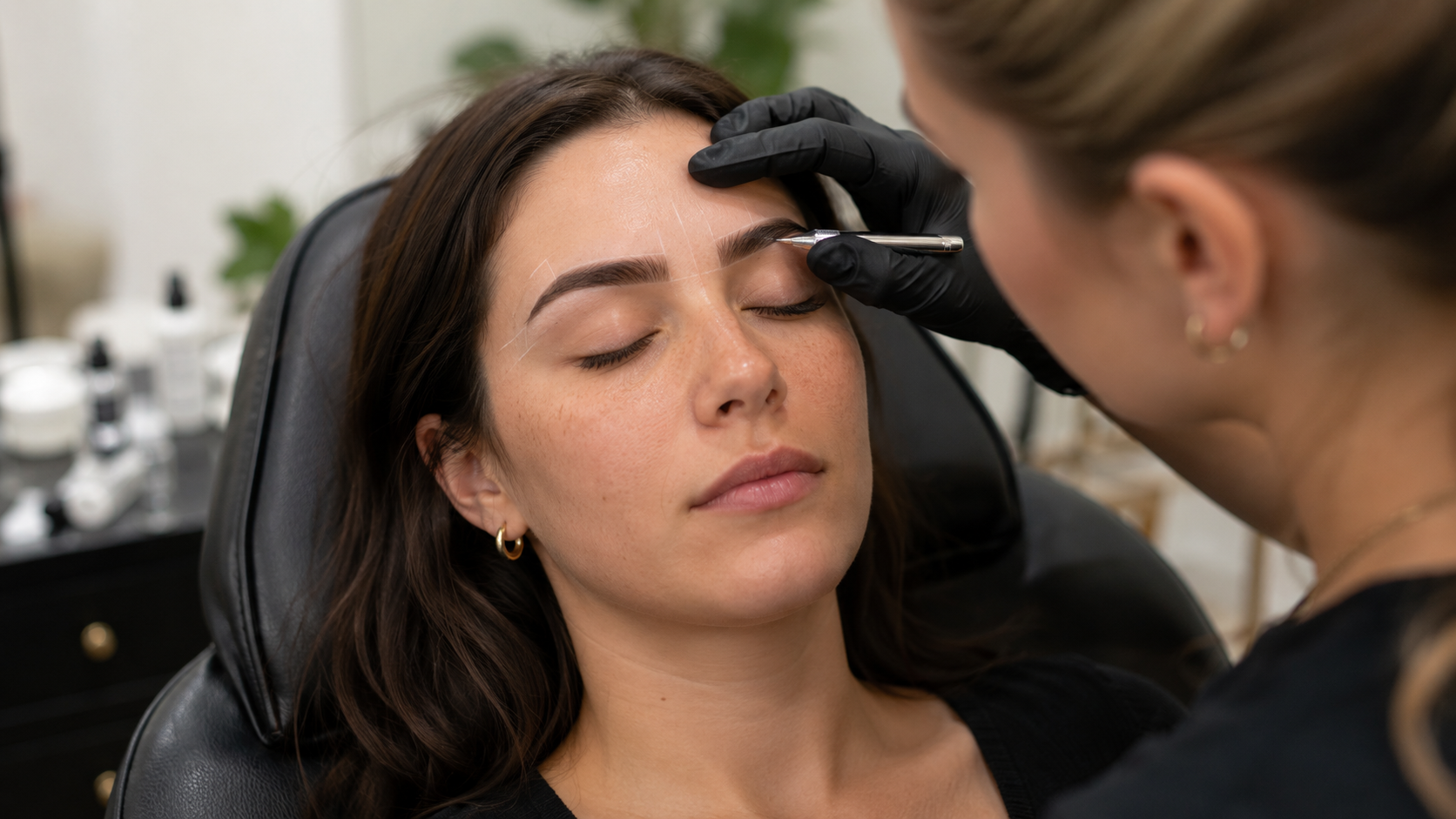
Your eyebrows frame every expression you make. When they’re off – too dark, too uniform, too obviously drawn – people notice something without knowing what. When they’re right, nobody notices anything at all. That’s the whole goal.
Permanent makeup is the category. Microblading is a specific technique. But most people researching it are asking the wrong question. They’re asking “is microblading good?” when the real question is “what makes one result look real and another look like a stamp?”
The answer isn’t the tool. It’s the decisions made before, during, and after the procedure – about shape, depth, pigment selection, skin type, and healing protocol. Microblading done well creates hair-like strokes that blend with your natural brows so completely that no one can tell where your real hair ends and the work begins. Done without those decisions in place, the result looks drawn, fades unevenly, or migrates.
Key Takeaways
- Brow shape is designed around your bone structure, not a template – symmetry is architectural, not mathematical
- Pigment color is matched to your skin’s undertone, not just your hair color
- Skin type is the single biggest variable in how long results last and how crisp strokes stay
- The touch-up appointment (typically 6-8 weeks post-procedure) isn’t optional – it’s where the result is completed
- Healing takes 4-6 weeks; what you see at day 3 is not your final result
Why Do So Many Microblading Results Look Fake?
The brow industry grew fast. Demand outpaced training, and for a while, the dominant aesthetic was bold, dark, and uniform – which photographs well but reads as artificial in person.
The problem isn’t the technique. A hand tool with a row of micro-needles depositing pigment into the upper dermis is capable of extraordinary realism. The problem is the decision-making layer that sits above the technique – the choices about where to place strokes, at what angle, with what color, and how deep.
Fake-looking microblading almost always comes from one of three errors: wrong shape for the face, wrong pigment for the skin tone, or strokes placed too deep. Each of these is a separate failure point, and each requires a separate skill to avoid.
Consider a common scenario: a client with naturally sparse brows books a microblading appointment and leaves with a result that looks beautiful in the mirror on day one. By week three, the strokes have blurred slightly and the color has shifted warmer. By month six, the brows look solid rather than hair-like. Nothing went catastrophically wrong – but the pigment was placed slightly too deep, and the color wasn’t selected with the skin’s warm undertone in mind. Two small decisions, compounded over time.
What Does the Shape Design Process Actually Involve?
Shape design is where the procedure is won or lost before a single stroke is made.
The process starts with mapping – using brow measurement ratios (the Phi method, which maps brow start, arch, and tail to facial landmarks using a measuring tool or caliper) to establish a framework. But mapping is a starting point, not a finish line. Your bone structure, the natural direction of your existing brow hair, your eye spacing, and your personal preferences all modify the mapped result.
At Million Dollar Brows, the shape consultation happens before any pigment is near the room. The mapped shape is drawn on with a removable pencil, you look at it, adjust it, and approve it. Nothing is permanent until you’ve seen it on your face.
The contrarian reality here: symmetry is not the goal. Your face isn’t symmetrical, and brows that are mathematically identical on both sides look wrong on most people. The goal is balance – brows that read as a matched pair when someone looks at your face, even if they’re slightly different in execution.
How Does Pigment Selection Actually Work?
Pigment selection is a two-variable problem: your hair color and your skin’s undertone. Most people understand the first variable. Almost no one thinks about the second until something goes wrong.
Skin undertones – warm (yellow/peach), cool (pink/blue), or neutral – affect how pigment heals. A cool-toned brown applied to warm-toned skin can shift ashy or grayish over time. A warm brown on cool skin can pull orange. The pigment you see in the cap is not the pigment you’ll see healed into your skin.
This is why experienced practitioners don’t pick pigment from a chart. They look at the veins on your wrist, the tone of your inner arm, and the color of your existing brow hair together – and then mix or select accordingly.
The stroke color should be one to two shades lighter than your natural brow hair. Pigment darkens slightly in the first few days post-procedure, then lightens as it heals. What looks right on day one is usually slightly too dark for the healed result.
Does Skin Type Change What’s Possible With Microblading?
Yes – and this is the variable most people don’t hear about until after they’ve booked.
Oily skin is the most significant factor limiting microblading results. The sebum produced by active oil glands sits in the upper dermis – exactly where microblading pigment is deposited. Over time, oil breaks down the pigment boundaries, causing strokes to blur and lose definition. This doesn’t mean microblading is impossible on oily skin, but it means the result will look softer and require more frequent touch-ups.
Dry skin and normal skin tend to hold strokes more crisply and retain pigment longer. Mature skin with some laxity requires lighter pressure and shallower strokes to avoid the pigment spreading.
This is also why ombre powder brows – a different permanent makeup technique that deposits pigment in a stippled, powdered pattern rather than individual strokes – is often a better fit for oily skin types. The ombre powder brows technique works with the skin’s behavior rather than against it.
The Healing Phase: What’s Actually Happening Under the Skin?
Pigment retention is not primarily a procedure problem – it’s a skin behavior problem.
Here’s the mechanism: microblading deposits pigment into the upper dermis. Your immune system immediately begins treating it as a foreign substance. Macrophage cells engulf pigment particles; some are expelled through the surface during healing, some are retained. What’s retained becomes your healed result. This process takes 4-6 weeks to complete.
During that window, the brows will look dark, then scab lightly, then appear to fade dramatically (sometimes alarmingly so), then gradually settle into their healed color. Day 10 is the ugliest day for most people. It’s also the day most people panic unnecessarily.
The touch-up appointment at 6-8 weeks exists because no practitioner can fully predict how your specific skin will retain pigment. The touch-up is where gaps are filled, color is corrected, and any strokes that didn’t retain are redone. Skipping it is the most common reason people end up with an uneven result.
How Does Microblading Compare to Other Permanent Makeup Options?
Not every brow technique is right for every person. Here’s an honest breakdown:
| Technique | Best For | Stroke Appearance | Oily Skin? | Longevity |
| Microblading | Sparse to medium brows, dry/normal skin | Hair-like, natural | Limited | 1-2 years |
| Ombre Powder Brows | All skin types, fuller look | Soft, powdered gradient | Yes | 2-3 years |
| Combination Brows | Sparse tails, defined front | Hair strokes + powder fill | Moderate | 1.5-2.5 years |
| Microshading | Sensitive or mature skin | Soft, diffused | Yes | 1.5-2 years |
The right technique is a clinical decision, not a preference decision. A practitioner who only offers one technique will fit you to their tool. A practitioner who offers several will fit the tool to your skin.
Million Dollar Brows offers multiple eyebrow enhancement options and assesses skin type, lifestyle, and aesthetic goals before recommending a technique – because the most natural-looking result comes from the right match, not the most popular option.
Who Isn’t a Good Candidate for Microblading Right Now?
Straight talk: some situations genuinely require waiting or choosing a different approach.
Active skin conditions on or near the brows – eczema, psoriasis, rosacea in the treatment area – can interfere with healing and pigment retention. Microblading during a flare-up often produces unpredictable results.
If you’re pregnant or nursing, most licensed practitioners will decline to perform the procedure – not because of documented harm, but because there’s insufficient safety data and the recommendation is to wait.
Isotretinoin (Accutane) use, current or recent, significantly affects skin healing. Most practitioners require a waiting period of 6-12 months after completing a course before performing any micropigmentation.
And if you’ve had recent sun damage or a significant tan in the brow area, the pigment color match becomes unreliable. Your healed skin tone is the baseline – not your summer tan.
None of these are permanent barriers. They’re timing questions. The permanent makeup consultation process at Million Dollar Brows includes a full skin and health assessment before any procedure is scheduled.
FAQ
How long does microblading actually last?
Most people see their microblading last between one and two years before a color refresh is needed. Oily skin, sun exposure, and certain skincare products (especially retinoids) accelerate fading. The touch-up at 6-8 weeks is included in the initial service and is where the result is completed – it’s not an upsell.
Does microblading hurt?
Most people describe it as a scratching sensation rather than pain. A topical numbing cream is applied before the procedure and reapplied as needed during it. Discomfort varies by individual pain tolerance and where you are in your cycle – some women find sensitivity is higher in the days before menstruation.
What if I don’t like the shape after it’s done?
This is exactly why the pre-procedure mapping and approval step matters. You see the drawn shape on your face before any pigment is introduced. If you don’t love it, it’s adjusted. Once the procedure is complete, significant shape changes require waiting for the pigment to fade – which is why the consultation isn’t a formality.
How do I know if I need microblading or ombre powder brows?
Skin type is the clearest guide. If you have oily skin or large pores in the brow area, ombre powder brows will hold better and look more consistent over time. If your skin is dry or normal and you want the most natural, hair-like result, microblading is typically the better fit. A practitioner who assesses your skin in person will give you a more reliable answer than any online quiz.
Can I wear makeup over microbladed brows?
Yes – after healing is complete (typically 4-6 weeks). During the healing phase, you’re asked to keep the brow area clean and dry, which means no makeup directly on the brows. Once healed, you can wear anything over them, though most clients find they don’t need to.
What should I avoid before my appointment?
In the week before your procedure: avoid alcohol, blood thinners like aspirin or ibuprofen (unless medically required), retinol or exfoliating products near the brow area, and excessive sun exposure. These affect either skin sensitivity or how the skin accepts pigment. Your practitioner will give you a complete pre-care list at booking.
How do I find a qualified microblading practitioner in New Hampshire?
New Hampshire law requires body art artists to complete 1,500 hours of an apprenticeship before practicing independently – one of the more demanding state standards in New England. Ask any practitioner you’re considering about their state licensure, their specific training in micropigmentation, and how many procedures they’ve performed. Volume and specialization matter: a practitioner who does brows all day, every day, develops a calibration that generalist salons don’t.
You Already Know What You Want – Here’s the Next Step
You want brows that look like yours, just better. Defined enough to frame your face, natural enough that no one can tell. That’s not a complicated task – but it requires a practitioner who treats shape design, pigment selection, and skin assessment as three separate decisions, not one.
If you’re ready to stop drawing them every morning, book a consultation at Million Dollar Brows. Walk in, have the conversation, see the mapped shape on your face before anything is permanent. That’s where the result actually starts.
Schedule your consultation or reach out by phone – Million Dollar Brows is open Monday through Saturday and serves clients across New Hampshire, Massachusetts, Maine, Connecticut, Rhode Island, and New York.
About the Author
Elizabeth is the founder of Million Dollar Brows and a licensed permanent makeup specialist in the state of New Hampshire. With over 1,000 procedures performed and more than a decade in the beauty industry, she specializes in microblading, microshading, ombre brows, eyeliner, and lip micropigmentation, with additional training in skin needling and collagen induction therapy. Million Dollar Brows is her Hampton Falls, NH-based clinic serving clients across the six-state New England region.