
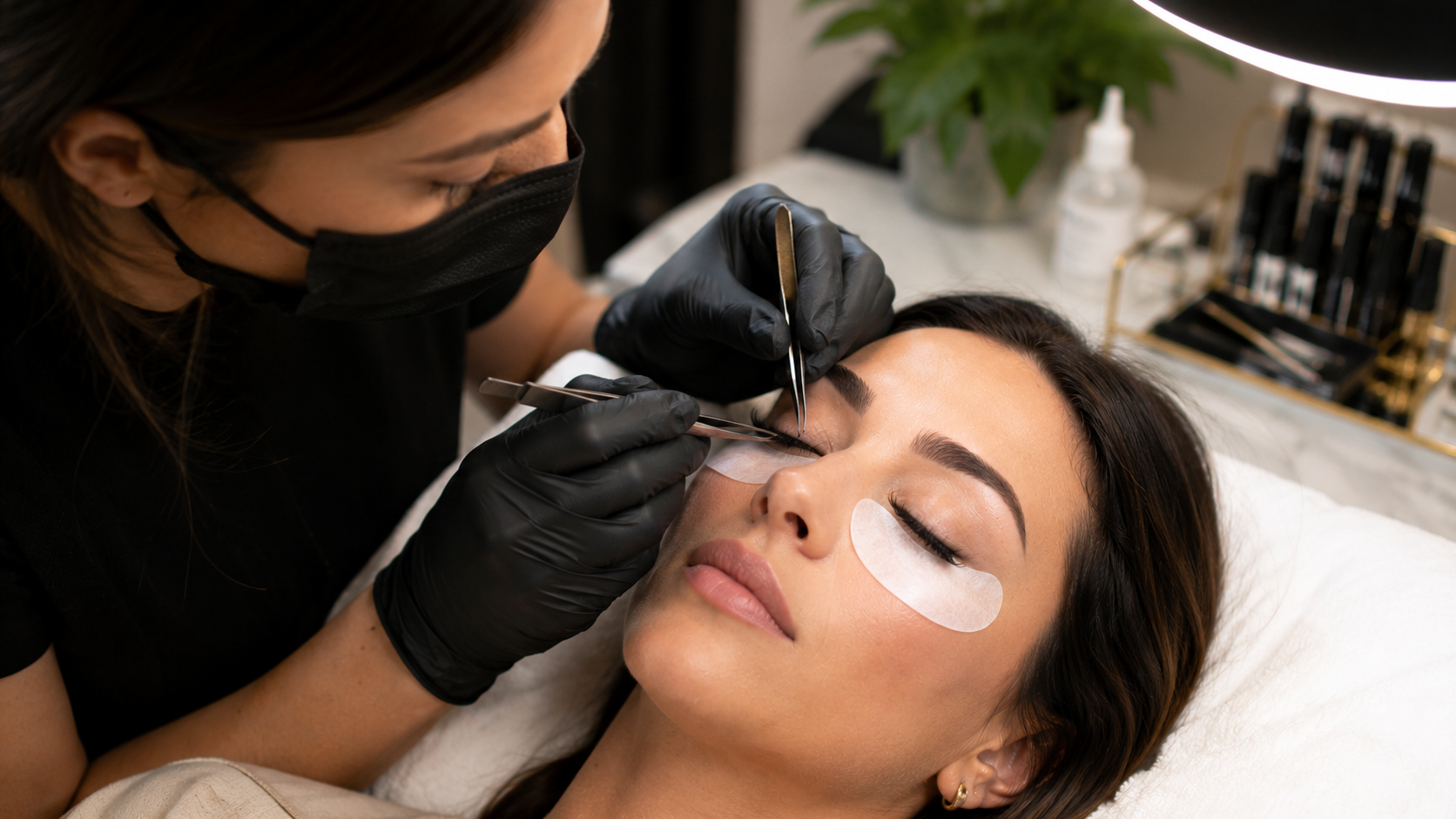
The search for a lash artist usually starts with Instagram. A few taps, a saved post, a DM – and suddenly you’re booking an appointment with someone whose work looks beautiful in a photo but whose actual technique, hygiene standards, and product quality you know almost nothing about.
That gap between what you see online and what actually happens on the table is exactly where the worst outcomes live.
Direct Answer
To evaluate an eyelash extension provider without being misled, look past the portfolio and assess four things: licensing and product transparency, isolation technique (each natural lash should be bonded individually), adhesive and material quality, and aftercare communication. A provider who can’t explain their process clearly before you book is unlikely to protect your natural lashes during the appointment.
Key Takeaways
- A polished portfolio proves photographic skill, not lash health – ask to see retention photos at 3-4 weeks, not just fresh-set shots
- The American Academy of Ophthalmology identifies eyelid infection, corneal infection, and temporary lash loss as documented risks of eyelash extensions – provider technique and hygiene directly affect your exposure to each
- Proper isolation (one extension bonded to one natural lash) is the single most important technical standard – poor isolation causes premature shedding and natural lash damage
- Adhesive quality and curing environment (humidity, temperature) matter more than most clients realize; a provider who doesn’t mention these variables probably isn’t controlling for them
- Convenience is only an asset when the work holds – a set that falls apart in ten days or damages your natural lashes costs more to fix than it saved you in time
Why Does Everyone’s Lash Work Look Good Online?
Because the photo is taken on day one.
Fresh extensions on a clean set look full, symmetrical, and dramatic in any lighting. What the photo doesn’t show is whether those lashes were properly isolated, whether the adhesive was appropriate for the client’s skin chemistry, or whether the natural lashes underneath are being slowly stressed by weight and poor bonding.
The portfolio problem is structural. A provider with genuinely excellent technique and a provider with genuinely poor technique can post nearly identical photos on day one. The difference shows up at week three – in retention, in natural lash health, and in whether you’re back for a fill or back for damage control.
The most confident portfolio is not the most trustworthy signal. Curated images are marketing. What you need is evidence of process.
What Actually Causes Lash Extension Problems – and Who’s Responsible for Preventing Them?
The American Academy of Ophthalmology identifies specific documented risks associated with eyelash extensions: infection or swelling of the eyelid, infection of the cornea, and temporary eyelash loss. These aren’t rare edge cases. They’re the predictable outcomes of poor technique, contaminated tools, and inappropriate adhesive use.
Here’s what drives each risk:
- Eyelid infection typically traces back to inadequate sanitation – reused tools, unclean work surfaces, or adhesive contact with the lash line
- Corneal irritation often results from fumes during application when the client’s eye isn’t properly protected or the adhesive is applied too close to the lid
- Temporary lash loss is almost always a technique problem – specifically, poor isolation where multiple natural lashes are bonded together, creating tension that pulls them out prematurely
The mechanism matters here. These aren’t random outcomes. They’re the direct result of choices the provider makes before you even sit down – what products they stock, how they prep their station, and whether they’ve been trained to isolate properly.
A provider who can walk you through each of these variables before your appointment isn’t just being thorough. They’re showing you they understand the causal chain between their choices and your outcome.
The Four-Point Evaluation Framework: What to Ask Before You Book
The Provider Accountability Framework is a four-question evaluation structure designed to separate technically sound providers from aesthetically convincing ones. Use it before any consultation, not after.
- Licensing and regulatory standing. In New Hampshire, body art artists are required by state law to complete 1,500 hours of an apprenticeship before practicing. Ask directly: are you licensed in this state? What training did you complete? A provider who deflects this question has answered it.
- Isolation protocol. Ask: “How do you ensure each extension is bonded to a single natural lash?” If they can’t explain their isolation technique – or if they describe it vaguely – that’s a technical gap. Proper isolation is non-negotiable. It’s the difference between a set that grows out cleanly and one that causes breakage.
- Adhesive and product transparency. Cyanoacrylate-based adhesives are standard in the industry, but formulations vary significantly in cure time, flexibility, and fume intensity. A provider should know exactly what they’re using and why it’s appropriate for your lash type and sensitivity level. If they can’t name the product or explain the selection rationale, they’re not controlling for the variables that affect your result.
- Retention evidence. Ask for photos at three to four weeks post-application, not just fresh sets. Retention at week three is a direct measure of isolation quality and adhesive performance. A provider who only shows day-one photos either doesn’t track retention or doesn’t want you to see it.
Is a Cheaper Set Ever the Right Call?
Consider a common scenario: a client books a discounted lash set from a provider she found through a deal site. The fresh set looks great. By week two, she notices clumping – multiple natural lashes bonded together, pulling and breaking as the extensions grow out. By the time she seeks a correction, she’s dealing with patchy natural lashes that need months to recover.
The correction appointment costs more than the original full set at a qualified provider would have.
The cost of the wrong provider isn’t the upfront price – it’s the recovery timeline. Natural lashes grow on a cycle of roughly six to eight weeks per phase. Damage that disrupts that cycle doesn’t resolve in a week. You’re looking at months, not days.
This is why eyelash extension services at a licensed, experienced clinic aren’t the expensive option. They’re the option that doesn’t require a second appointment to undo the first one.
How Does Provider Quality Compare to DIY or Discount Options?
| Factor | Unvetted / Discount Provider | Qualified Provider (e.g., Million Dollar Brows) |
| Isolation technique | Inconsistent – often multiple lashes bonded | One extension per natural lash, standard practice |
| Product transparency | Adhesive brand often unknown | Specific products selected for lash type and sensitivity |
| Hygiene standards | Varies; no regulatory accountability | State-licensed; sanitation standards enforced |
| Retention at 3-4 weeks | Unpredictable; often poor | Consistent with proper prep and aftercare |
| Risk of natural lash damage | Higher – poor isolation causes breakage | Lower – technique protects the natural lash cycle |
| Recovery cost if something goes wrong | High – damage takes months to resolve | Low – proper technique prevents most complications |
The axes here aren’t “expensive vs. affordable.” They’re “protected vs. exposed.” The downside of the wrong choice isn’t just a bad lash set – it’s a months-long recovery and the cost of fixing work that should have been done right the first time.
Who Should Prioritize This Framework Most?
If you have sensitive eyes, a history of contact lens wear, or known cosmetic allergies, provider vetting isn’t optional – it’s the entire decision. Adhesive fumes and improper application are the primary triggers for the reactions the American Academy of Ophthalmology flags, and your baseline sensitivity raises your exposure to each.
If you’re a busy professional who can’t afford a week of irritated, watery eyes or a lash set that falls apart before your next important meeting, the evaluation framework above isn’t extra due diligence. It’s basic protection.
For women across New England managing packed schedules, the whole point of semi-permanent lash and brow services is that they save time. A set that fails in ten days doesn’t save you anything. It adds a corrective appointment to your calendar.
What This Framework Doesn’t Cover
No evaluation framework eliminates all risk. Your skin chemistry, natural lash health, hormonal changes, and how closely you follow aftercare instructions all affect your outcome – and none of those are fully in the provider’s control.
A qualified provider will tell you this upfront. They’ll explain what they can control (isolation, adhesive selection, application environment) and what they can’t (your natural lash cycle, how your skin responds to adhesive). That honesty isn’t a red flag. It’s the clearest sign you’re talking to someone who actually knows what they’re doing.
What this framework also doesn’t replace is a real consultation. Reading a checklist online is useful. Sitting across from a practitioner who can assess your natural lash density, discuss your lifestyle, and recommend the right extension weight and style for your specific situation is different in kind, not just degree.
Million Dollar Brows offers consultations before any lash service – not as a formality, but because the assessment shapes the result. You can read what clients say about that process before you decide.
FAQ
How do I know if my lash artist is actually licensed?
Ask directly, and ask which state they’re licensed in – not just whether they have “certifications.” In New Hampshire, licensing for body art artists requires completing 1,500 hours of apprenticeship. A legitimate provider will answer this without hesitation and can show documentation if you ask.
What does poor isolation actually feel like, and will I notice it during the appointment?
You probably won’t notice it during the appointment – it’s a technique issue that shows up later. Poor isolation means multiple natural lashes are bonded together; as they grow at different rates, they pull against each other. You’ll notice it as premature shedding, clumping at two to three weeks, or a feeling of tightness near the lash line.
Is it safe to get eyelash extensions if I wear contact lenses?
Most providers recommend removing contacts before an appointment and waiting at least a few hours after before reinserting them. Adhesive fumes can cause irritation in contact lens wearers. A qualified provider will ask about this during intake – if they don’t, bring it up yourself.
How long should a quality lash set actually last?
A properly applied set with good isolation and appropriate adhesive should retain well through a three-to-four week fill cycle. You’ll naturally lose some extensions as your natural lashes shed – that’s normal. Losing significant volume before two weeks usually points to an isolation or adhesive issue, not just natural shedding.
What’s the difference between a lash lift and eyelash extensions – which one is right for me?
A lash lift works with your existing natural lashes, curling and setting them for a more open-eyed look without adding length or volume. Extensions add individual synthetic lashes for more dramatic fullness. If you have decent natural lash length and want low-maintenance results, a lift is often the cleaner option. If you want more volume or length, extensions are the right call.
Can I get eyelash extensions if I have sensitive eyes or cosmetic allergies?
Possibly, but it requires a more careful provider selection process. Adhesive formulations vary, and some are better tolerated by sensitive skin than others. A qualified provider will do a patch test and ask about your allergy history before proceeding. Don’t skip that step – and don’t book with anyone who treats it as unnecessary.
What questions should I ask at a lash consultation to know if the provider is actually qualified?
Ask about their isolation technique, what adhesive they use and why, how they handle clients with sensitive eyes, and whether they can show you retention photos at three to four weeks. A provider who can answer all four clearly – without deflecting or getting vague – has demonstrated more than most portfolios will ever show you.
You’ve Done the Research. Now Book With Someone Who Can Back It Up.
If you’ve read this far, you’re not looking for the cheapest option or the most dramatic set. You’re looking for work that holds, that protects your natural lashes, and that fits into a schedule that doesn’t have room for corrective appointments.
That’s exactly what Million Dollar Brows is built for. Elizabeth is state-licensed in New Hampshire, has completed over 1,000 procedures, and approaches every lash consultation the same way: assess the client first, recommend the right service second. The permanent makeup clinic in Hampton Falls, NH is open Monday through Saturday and serves clients across all six New England states.
Book online or by phone. Come in knowing what good work looks like – and leave with proof of it.
About the Author
Elizabeth is a licensed permanent makeup and body art specialist based in Hampton Falls, New Hampshire. With over a decade in the beauty industry and more than 1,000 procedures completed, she specializes in permanent cosmetics including microblading, microshading, ombre brows, eyeliner, and lash services. She founded Million Dollar Brows to give busy professionals across New England a reliable, natural-looking alternative to daily makeup application.
References
American Academy of Ophthalmology – documented risks of eyelash extensions including eyelid infection, corneal infection, and temporary lash loss