
Most women who walk into a brow appointment have spent more time researching the procedure on their phone than they have on any single work project this month. And they still leave with questions they didn’t think to ask until they’re already in the car. That gap between what you read online and what actually happens in the chair is exactly where confusion, disappointment, and avoidable mistakes live.
Before booking professional brow services, clients should know that a thorough consultation comes first, skin preparation affects how pigment retains, and the healing process takes four to six weeks. Not four to six days. Choosing a licensed, experienced technician is the single most consequential decision in the process. The result is only as good as the preparation behind it.
Key Takeaways
• A consultation is not optional. It determines whether you’re a good candidate and what technique suits your skin type.
• Avoid retinol, blood thinners, and sun exposure for at least two weeks before your appointment.
• Full healing takes four to six weeks; the brows will appear darker and slightly uneven before they settle.
• A qualified technician holds state licensure and documented training hours. Not just a certificate from a weekend course.
• Touch-up appointments, typically scheduled six to eight weeks after the initial procedure, are part of the process, not a sign something went wrong.
Why Do So Many Brow Procedures Fall Short of Expectations?
The real problem isn’t the technique. It’s the information gap that exists between the moment someone decides they want professional brow services and the moment they sit down for the procedure.
Most people arrive at an appointment with a mental image borrowed from someone else’s result. A photo, a friend’s brows, a before-and-after they saved three months ago. What they don’t arrive with is an understanding of their own skin, their own healing pattern, or what the procedure can and cannot do for their specific face.
The gap between expectation and outcome is almost never about skill alone. It’s about preparation that didn’t happen.
This is a category where the client’s role in the outcome is genuinely significant. That’s not a disclaimer. It’s the actual mechanism.
What Actually Happens During a Brow Consultation?
A brow consultation is a structured pre-procedure assessment in which the technician evaluates skin type, facial symmetry, existing brow hair, and the client’s lifestyle and goals before any technique is selected.
This is not a formality. Oily skin retains pigment differently than dry skin. Mature skin has different texture considerations than younger skin. A client who swims daily has different aftercare challenges than someone who works at a desk. All of that shapes which procedure makes sense. Microblading, microshading, ombre brows, or a combination approach.
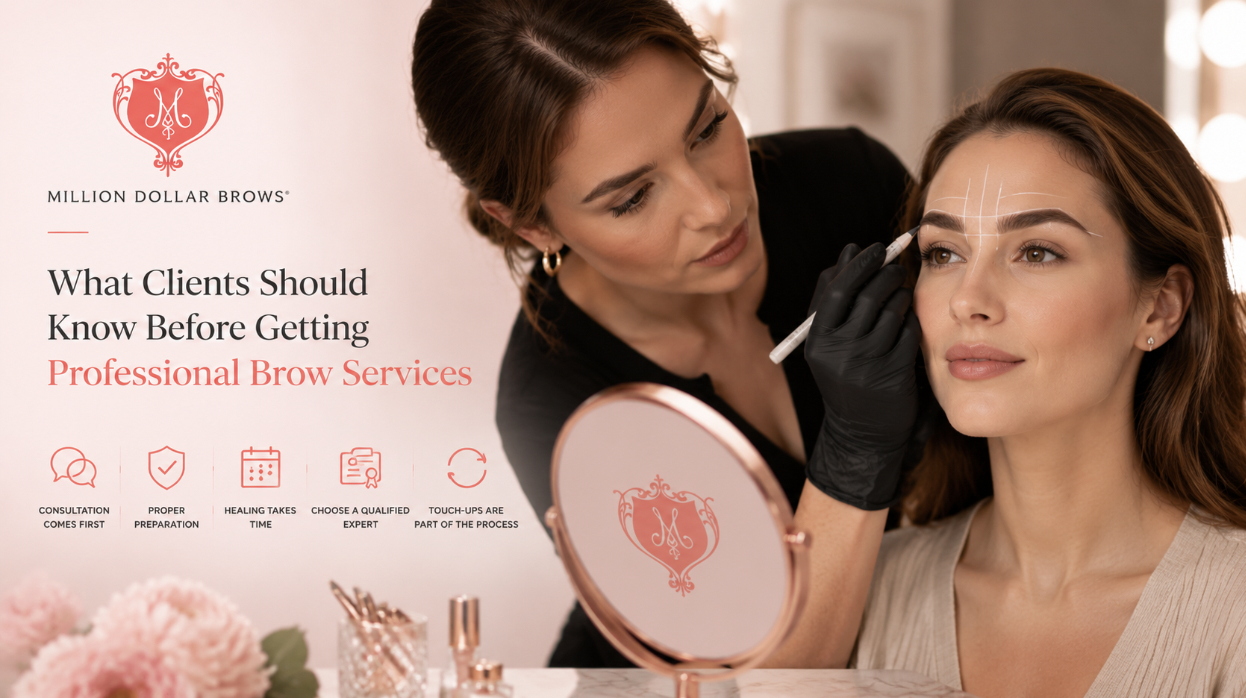
During a consultation at Million Dollar Brows, Elizabeth maps brow shape to facial structure before a single stroke is placed. The goal is always proportion that looks like it belongs to your face. Not a shape borrowed from a trend.
The best brow result is the one that looks like you never had a procedure. Just better brows than you woke up with yesterday.
Clients should come prepared to discuss: any skin conditions or sensitivities, current skincare products (especially actives like retinol or acids), medical history that may affect healing, and what they dislike about their current brows. Bring reference photos. But hold them loosely. A good technician will use them as a starting point, not a template.
How Should You Prepare Your Skin Before a Brow Appointment?
Skin preparation is where most clients underestimate their own role. The condition of your skin on the day of the procedure directly affects how evenly pigment is deposited and how well it heals.
The standard pre-procedure protocol most experienced technicians follow:
• Stop retinol and exfoliating acids at least two weeks before the appointment. These thin the skin and compromise pigment retention.
• Avoid blood-thinning medications and supplements, including aspirin, fish oil, and vitamin E, for at least 48 hours prior, unless medically necessary (always consult your physician).
• No alcohol for 24 hours before the procedure. Alcohol thins the blood and increases bleeding, which pushes pigment out of the skin.
• Stay out of direct sun for two weeks prior. Sunburned or recently tanned skin does not hold pigment consistently.
• Do not wax or thread the brow area for at least a week before your appointment.
One operational pattern practitioners see repeatedly: a client who followed every preparation instruction heals with crisp, even strokes. A client who had a glass of wine the night before and forgot about the retinol she used three days ago heals with patchy, faded results. And attributes it to the technician.
Preparation is not a suggestion. It’s half the result.
What Does the Healing Timeline Actually Look Like?
Healing timeline is the most misunderstood part of the entire professional brow services process. And the most common source of post-procedure panic.
Here is what a realistic four-to-six-week healing arc looks like:
| Week | What You’ll See | What It Means |
| Days 1-3 | Brows appear very dark, slightly swollen | Normal inflammatory response |
| Days 4-7 | Flaking and peeling begins | Outer skin layer shedding. Do not pick |
| Week 2 | Brows look faded, patchy, possibly “gone” | Pigment settling under the skin |
| Weeks 3-4 | Color begins to resurface, unevenly | Deeper layers of skin healing |
| Weeks 5-6 | Final result becomes visible | Skin fully healed, pigment stabilized |
The “ghost phase”, when brows appear to have almost disappeared around week two, is not a failed procedure. It is a predictable, documented stage of micropigmentation healing.
Clients who know this in advance stay calm. Clients who don’t call their technician in a panic, assume the worst, and sometimes apply products they shouldn’t.
Aftercare during this window is specific: keep brows dry for the first ten days, apply only the recommended healing balm, avoid sweating heavily, and stay out of pools and direct sun. Missing any of these steps affects the final result.
The touch-up appointment at six to eight weeks exists precisely because healing is individual. Some areas retain pigment better than others. The touch-up corrects those variations. It is a built-in part of the process, not an upsell.
How Do You Know If a Brow Technician Is Actually Qualified?
This is where the contrarian claim needs to be stated plainly: a beautiful portfolio is not proof of competency. It is proof of best-case results.
What actually signals qualification:
• State licensure. In New Hampshire, body art artists are required by law to complete 1,500 hours of apprenticeship before practicing. That is not a weekend course. That is a meaningful credential.
• Documented training across multiple techniques. Microblading, microshading, ombre brows, and combination brows require different skill sets.
• A consultation process. A technician who skips the consultation and goes straight to booking is skipping the step that protects you.
• Transparent aftercare instructions. Provided in writing, before the procedure, not handed to you on your way out the door.
Elizabeth at Million Dollar Brows holds New Hampshire state licensure, has completed training across multiple states, and has performed over 1,000 procedures. That volume matters because pattern recognition, knowing when a skin type will heal differently, when a shape needs adjustment before the first stroke, comes from repetition, not just training. Technicians who invest in professional-grade tools such as disposable microblading pens and supplies further reduce cross-contamination risk and support consistent, clean results.
Choosing a brow technician based on price or proximity is the most expensive decision you can make in this category. The correction work costs more than the original procedure done right.
The Convenience Reframe: This Isn’t a Beauty Appointment, It’s a Time Investment
Here is where most people think about professional brow services wrong.
They frame it as a beauty expense. The more accurate frame is a time investment with a measurable daily return.
Consider: if getting your brows ready takes ten minutes each morning, filling, shaping, fixing, that is roughly sixty hours per year spent on a single step of your routine. Professional brow services eliminate that step, consistently, for one to three years depending on the technique and your skin.
That is not a beauty decision. That is a schedule decision.
For busy professionals in New England who are already managing erratic schedules, early mornings, and the kind of days where getting out the door on time is a genuine achievement. Waking up with brows that are already done is not a small thing.
Million Dollar Brows serves clients across New Hampshire, Massachusetts, Maine, Connecticut, New York, and Rhode Island specifically because this kind of convenience doesn’t belong only to people who live near a major city.
Who Is This Not For?
Professional brow services are not the right fit for everyone, and a trustworthy technician will tell you that directly.
Microblading specifically is not recommended for: clients currently on Accutane or who have used it within the past year, clients with certain skin conditions including eczema or psoriasis in the brow area, clients who are pregnant or nursing, or clients with a history of keloid scarring.
Oily skin types may find that microblading strokes blur over time more quickly than on drier skin. In those cases, microshading or an ombre technique often produces a longer-lasting result. This is a conversation to have during the consultation, not after the procedure. The Biotek warm dark brown brow pigment is one example of a professional-grade pigment formulated specifically for varying skin tones and types, illustrating how tailored color selection also plays a role in achieving a lasting result.
If you are not willing to follow aftercare instructions, no picking, no sweating, no sun, no skipping the touch-up, the investment will not perform as expected.
FAQ: What People Actually Ask Before Booking
How much does microblading hurt?
Most clients describe it as light scratching rather than pain. A topical numbing cream is applied before the procedure begins. Sensitivity varies by individual and by where you are in your menstrual cycle, but practitioners consistently report that discomfort is manageable and brief.
How long do professional brow services actually last?
Microblading typically lasts twelve to eighteen months before a refresh is needed. Microshading and ombre techniques often last longer, up to two to three years, because the technique deposits pigment more densely. Longevity depends on skin type, sun exposure, and skincare routine.
What if I don’t like the shape after it heals?
This is why the consultation and the touch-up appointment both matter. Shape corrections can be made at the six-to-eight-week touch-up once the skin is fully healed. Significant changes are difficult to make without a removal process, which is why communicating clearly during the consultation is so important.
Can I still wear brow makeup after getting professional brow services?
Yes. Semi-permanent brows are an enhancement, not a replacement for everything. Once fully healed, you can add pencil or powder on top if you want more definition for a specific occasion.
Is it safe if I have sensitive skin or cosmetic allergies?
This is one of the strongest cases for professional brow services. Clients who react to conventional brow makeup often find semi-permanent pigments more tolerable because they eliminate daily product contact. A patch test prior to the procedure is the appropriate step for anyone with known sensitivities.
What should I do if my brows look uneven right after the procedure?
Wait. Uneven appearance in the first two weeks is almost always a healing artifact, not a permanent result. The touch-up appointment is designed to address any asymmetry that remains once the skin has fully healed.
How do I find out if I’m a good candidate without committing to a booking?
Contact the studio directly and ask for a consultation. Million Dollar Brows offers both phone and online booking, and a consultation before committing to a procedure is standard practice. Not an imposition.
Ready to Wake Up With Brows That Are Already Done?
If you’ve read this far, you’re not just curious. You’re close to deciding. The next step is a consultation, not a commitment. It’s the conversation where you find out what technique suits your skin, what your brows could look like, and whether the timing works for your schedule.
Million Dollar Brows is open Monday through Saturday and serves clients across New England. Book your brow appointment online or by phone. And stop spending sixty hours a year on a step you could handle once.
Book Your Appointment at Million Dollar Brows
About the Author
Elizabeth is the founder of Million Dollar Brows and a New Hampshire state-licensed permanent makeup specialist. With over ten years in the beauty industry and more than 1,000 procedures performed, she specializes in microblading, microshading, ombre brows, eyeliner, and lip procedures, with advanced training completed across multiple states. Million Dollar Brows is her clinic serving clients throughout the six-state New England region.
References
New Hampshire Division of Public Health Services. Body Art Program licensing requirements, including the 1,500-hour apprenticeship mandate for body art artists in the state of New Hampshire.