
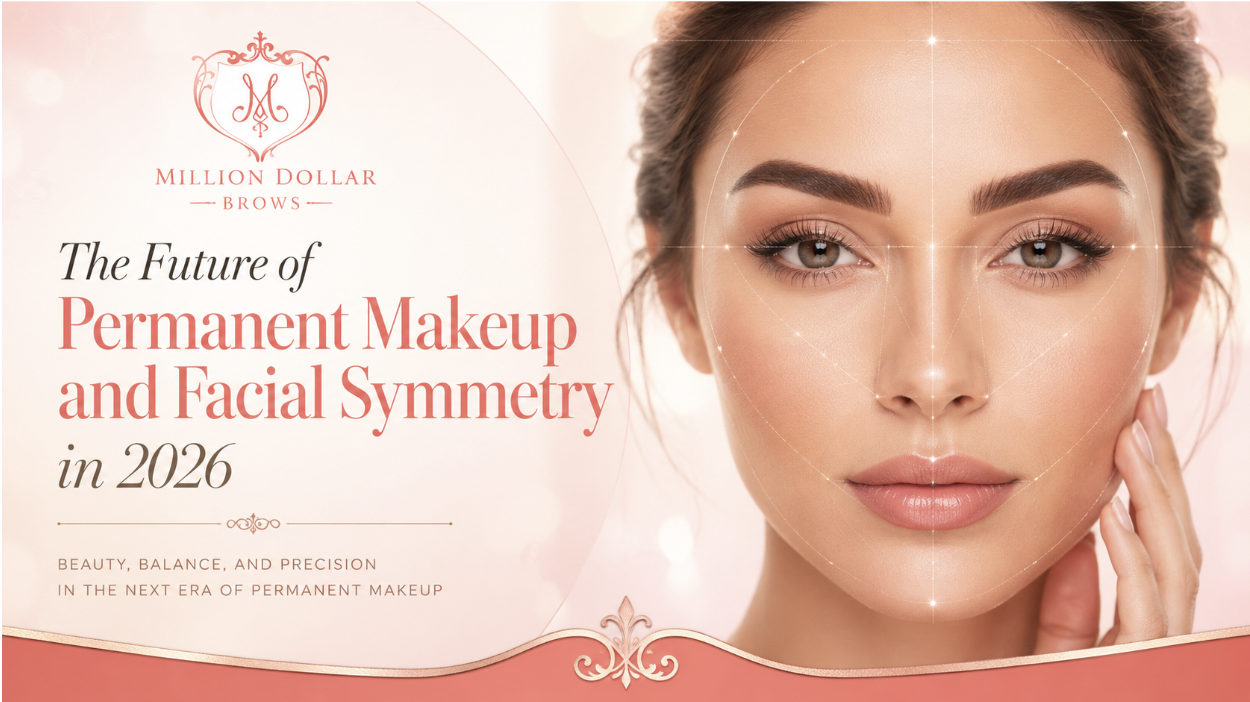
Most women spend more time correcting their brows in the mirror than they realize. Not because they lack skill, but because they are working against their own face without a map. Facial symmetry analysis is changing that, and permanent makeup is the delivery system making it practical.
Facial symmetry brows refers to the practice of using anatomical mapping, measuring the natural proportions of a client’s face, bone structure, and feature placement, to design eyebrow shape, arch, and thickness before any pigment is applied. When done correctly, symmetry-based brow design does not create identical brows. It creates balanced ones, calibrated to the individual face. The result looks natural precisely because it follows the face’s own logic.
Key Takeaways
• Facial symmetry in brow artistry is not about making both brows identical. It is about designing each brow to balance the face as a whole
• Advanced mapping tools and digital consultation methods are helping practitioners achieve more consistent, personalized results
• Semi-permanent and permanent brow techniques have different maintenance timelines, and choosing the right one depends on lifestyle and skin type
• Not every client is a good candidate. Skin conditions, certain medications, and unrealistic expectations are genuine disqualifiers
• Long-term brow maintenance follows a predictable refresh cycle that most busy professionals find easier to manage than daily makeup
Why Do Brows That Look Good in the Mirror Still Feel “Off” on Camera?
The answer is not lighting. It is asymmetry. And most people have more of it than they think.
Human faces are naturally asymmetric. Research in facial perception consistently shows that people read faces as more attractive and trustworthy when the two halves are in relative balance, not when they are mirror images. The distinction matters because it explains why brows drawn to look identical in a flat mirror can appear uneven in photographs, on video calls, or in different lighting conditions.
The real problem is that most daily brow routines are reactive, not architectural. A person fills in what looks sparse, darkens what looks light, and calls it done. There is no reference to bone structure, no measurement of the brow-to-eye distance, no consideration of how the arch height interacts with the outer corner of the eye.
This is the gap that facial symmetry analysis closes.
Brows drawn to match each other are not the same as brows designed to balance a face. And that difference is visible every time the camera comes out.
What Is Facial Symmetry Analysis, and How Does It Actually Work in Permanent Makeup?
Facial symmetry analysis is a structured mapping process that measures key anatomical landmarks. The inner corners of the eyes, the outer corners, the highest point of the natural arch, and the relationship between the brow and the pupil. To establish proportional guidelines before any permanent pigment is applied.
The classical reference point is the Phi ratio (approximately 1:1.618), a proportional relationship observed in facial aesthetics that practitioners use as a starting benchmark, not a rigid rule. In practice, this means measuring where the brow should begin relative to the nostril, where the arch should peak relative to the iris, and where the tail should end relative to the outer corner of the eye.
At Million Dollar Brows, this mapping step happens before the consultation ends. Not as an afterthought before the procedure begins. The reason is practical: a client who can see the proposed shape drawn on her face before any commitment is made is a client who arrives at the procedure with realistic expectations. That alignment between expectation and outcome is what produces the results people actually share.
The process also accounts for facial movement. A brow that sits correctly when the face is relaxed may look different when the client smiles or raises her forehead. Experienced practitioners test the proposed shape against natural expression. A step that textbook symmetry formulas alone cannot replicate.
Are New Technologies Actually Changing Brow Consultations, or Is This Just Marketing?
Mostly the former, with some of the latter mixed in.
Digital imaging tools, including apps that overlay brow shape guides onto photographs and software that maps facial landmarks in real time, are genuinely useful for pre-procedure planning. They allow a practitioner to show a client what a proposed arch height or tail length will look like before anything is marked on skin. That reduces the single biggest source of post-procedure dissatisfaction: the gap between what a client imagined and what was actually applied.
What technology does not replace is the practitioner’s judgment about skin behavior. Pigment heals differently in oily skin versus dry skin, in mature skin versus younger skin, and in previously tattooed areas versus untouched skin. A digital overlay cannot predict how a color will oxidize over six weeks. A trained eye and a decade of hands-on experience can make a reasonable prediction. And adjust accordingly.
Technology narrows the gap between expectation and outcome. It does not replace the practitioner who knows how skin actually heals.
Million Dollar Brows uses consultation-stage assessment to combine both: visual planning tools for client communication and hands-on evaluation for technical decisions. The result is a process where the client is genuinely informed, not just reassured.
What Are the Advanced Permanent Makeup Techniques Reshaping Brow Artistry Right Now?
The field has moved well past basic microblading as a single standard.
| Technique | Best For | Longevity | Finish |
| Microblading | Normal to dry skin, sparse brows | 12-18 months | Hair-stroke, natural |
| Microshading | Oily or combination skin, fuller look | 18-24 months | Soft powder, defined |
| Ombre Brows | All skin types, gradient effect | 18-24 months | Shaded, polished |
| Combination Brows | Sparse + needs definition | 12-18 months | Natural with structure |
| Nano Brows | Fine detail, sensitive skin | 12-24 months | Ultra-realistic strokes |
The contrarian truth here: microblading is not always the most natural-looking option. For clients with oily skin, microbladed strokes can blur and spread as the skin produces more sebum. Resulting in a less defined look within months. Microshading or ombre techniques often hold better and look more intentional on oily skin types, even though they are less frequently marketed as the “natural” choice.
This is where the practitioner’s assessment of skin type at consultation becomes the most important variable in the entire process. More important than the client’s preference for a specific technique. Practitioners who want to explore a full range of pigment options can browse professional permanent makeup supplies to see what tools and pigments support each technique.
The Symmetry-First Framework: A Decision Tool for Brow Design
The Symmetry-First Framework is a three-stage assessment process used to sequence brow design decisions in permanent makeup. Structure before style, balance before preference, skin behavior before technique selection.
Use it when: a client has asymmetric features, uneven natural brows, or has had previous permanent brow work that needs correction.
Not when: a client has strong, even natural brows and is seeking enhancement only. In that case, the existing structure is the map.
The three stages:
1. Map first. Establish anatomical landmarks before discussing shape preferences. What the face needs structurally is the starting point.
2. Simulate second. Show the proposed shape on the client’s actual face, drawn, overlaid, or photographed, before any commitment.
3. Select technique third. Only after structure and simulation are confirmed, choose the technique based on skin type, lifestyle, and desired finish.
Most dissatisfied permanent makeup outcomes skip stage two. The client approves a verbal description, not a visual one, and the gap between imagination and result becomes visible only after healing.
Long-Term Brow Maintenance: What Does “Permanent” Actually Mean in Practice?
Permanent makeup is a misleading term for most people encountering it for the first time.
Semi-permanent brow techniques, microblading, microshading, ombre brows, deposit pigment into the upper dermis, not the deep dermis where traditional tattoo ink sits. This means the color fades over time as the skin naturally turns over. Most clients need a touch-up between 12 and 24 months depending on technique, skin type, sun exposure, and skincare habits. The quality of the pigment used plays a significant role in how true the color stays. Professional-grade options like Biotouch micropigment for permanent eyebrow makeup are formulated specifically to maintain tone through the fade cycle.
For a busy professional managing an erratic schedule across New England, this is actually a feature, not a limitation. The fade cycle means the brows can be adjusted as the client’s face changes, style preferences shift, or a correction is needed. Without being locked into a permanent result.
A practical example: a client who starts with microblading at 35 may transition to microshading at 45 as her skin changes and she prefers a slightly more defined look. The fade cycle creates that flexibility.
The maintenance rhythm most practitioners observe: an initial procedure, a 6-to-8-week perfecting session to address any uneven healing, and then annual or biannual touch-ups depending on the technique. That is two to three appointments per year, replacing a daily routine that takes 10 to 20 minutes every morning.
Who Is This Not For?
This is worth stating plainly, because trust matters more than a full appointment book.
Permanent makeup procedures are not appropriate for clients who are pregnant or breastfeeding, currently undergoing chemotherapy, taking blood thinners, or managing active skin conditions like eczema or psoriasis in the treatment area. Clients with a history of keloid scarring should approach with caution and a direct conversation with their practitioner.
Clients with unrealistic expectations about symmetry are also not good candidates. Not because the technique cannot help, but because no procedure can produce perfect bilateral symmetry on a naturally asymmetric face. The goal is balance, not mathematical equality.
And clients who want a dramatic, heavily defined brow look should understand that the most natural-looking results require restraint. If the goal is a bold, high-contrast brow, that is achievable. But it requires a different technique and a clear-eyed conversation about what “natural” means to that specific client. For those exploring a defined, high-contrast finish, a brow pomade for long-lasting definition can help clients visualize that look before committing to a permanent procedure.
FAQ
How long does a microblading appointment actually take from start to finish?
Most initial microblading sessions run between two and two-and-a-half hours, including the consultation, mapping, and the procedure itself. The follow-up perfecting session at six to eight weeks is typically shorter. Around 60 to 90 minutes. Plan for the full block on your first visit.
Will the color look too dark or obvious right after the procedure?
Yes, and that is normal. Freshly applied pigment appears significantly darker for the first seven to ten days while the skin heals. The color softens and lightens by roughly 30 to 40 percent after the initial healing phase. Which is why the six-to-eight-week touch-up exists, to correct any unevenness after the true healed result is visible.
I have oily skin. Am I a good candidate for microblading?
Oily skin is not a disqualifier, but it does change the recommendation. Microbladed hair strokes tend to blur faster in oily skin types, often within the first year. Microshading or ombre techniques generally hold better and maintain their definition longer on oily skin. A practitioner who assesses your skin type at consultation should be steering this conversation, not just taking your technique preference at face value.
Can permanent makeup correct brows that are already uneven from years of over-tweezing?
In many cases, yes. Symmetry-based mapping can establish a new brow shape that works with the existing hair and compensates for sparse or missing areas. Severely over-tweezed brows with little remaining hair may need a technique that creates the illusion of fullness through shading rather than individual hair strokes. The consultation assessment determines what is achievable.
How do I know if a practitioner is actually qualified, or just certified by a weekend course?
This is the right question to ask. In New Hampshire, state law requires body art artists to complete 1,500 hours of an apprenticeship before licensure. A significantly higher bar than a weekend certification course. Ask specifically about state licensure, the number of procedures completed, and whether you can see a portfolio of healed results, not just freshly done work. Healed results are the honest measure.
What happens if I do not like the result after it heals?
The perfecting session at six to eight weeks is specifically designed to address healing irregularities and make adjustments. For more significant changes, the fade cycle works in the client’s favor. Semi-permanent pigment lightens over 12 to 24 months, and corrections can be made at touch-up appointments. Laser removal is an option for permanent results, but most semi-permanent work does not require it.
Is there anything I need to stop using on my skin before a brow procedure?
Yes. Retinol and retinoid products, exfoliating acids, and certain prescription topicals should be paused in the treatment area for a period before the procedure. Your practitioner will give you specific timing based on the products you use. Sun exposure and tanning should also be minimized in the weeks prior. Coming in with sunburned or recently exfoliated skin affects how the pigment takes and how evenly it heals.
Ready to Stop Guessing at Your Brows Every Morning?
If you have read this far, you already know the difference between brows that are drawn to match and brows that are designed to balance. That distinction is exactly what the team at Million Dollar Brows brings to every consultation. Symmetry mapping, skin assessment, and a clear conversation about what your face actually needs before any commitment is made.
Serving clients across New Hampshire, Massachusetts, Connecticut, Maine, Rhode Island, and New York, Million Dollar Brows is open Monday through Saturday with online and phone booking available. The first step is a consultation where the map is drawn before any decisions are final.
Book your brow consultation with Million Dollar Brows and arrive knowing exactly what your result will look like. Before the procedure begins.
Visit milliondollarbrows.com or call to schedule.
About the Author
Elizabeth is the founder of Million Dollar Brows and a New Hampshire-licensed permanent makeup specialist with over ten years of experience in the beauty industry. She has completed more than 1,000 procedures and holds certifications across multiple states, specializing in microblading, microshading, ombre brows, eyeliner, and lip procedures. New Hampshire law requires 1,500 hours of apprenticeship for licensure. A standard Elizabeth meets and considers the baseline, not the ceiling.
References
Bureau of Labor Statistics. Occupational and licensing data for cosmetology and body art practitioners in the United States.
American Academy of Facial Esthetics. Published guidelines on facial proportion and the Phi ratio in aesthetic treatment planning.
New Hampshire Office of Professional Licensure and Certification. State requirements for body art artist licensure, including apprenticeship hour mandates.